
Proving Data Integrity with Blockchain Technology
Published on:
Proving data integrity in legal, compliance, and records-intensive environments requires more than secure storage. Organizations increasingly need to demonstrate that a record existed at a specific point in time, has not been altered, and can be independently verified. That is where blockchain technology becomes especially valuable for electronic documentary evidence.
Rather than placing the underlying file or personal data on a blockchain, a system can generate a cryptographic hash of the record and anchor that proof to a blockchain. The result is a tamper-evident integrity layer that supports proof of existence, proof of data integrity, audit readiness, and evidentiary support.
For platforms like Lexkeep, this is supported by a seamless File Integrity Evidence Report prepared for verification, audit, compliance, and evidentiary support purposes. Each report includes a Lexkeep verification link and a blockchain explorer link, enabling recipients to independently validate the integrity proof through both the platform and the underlying blockchain record.
What Is Proof of Data Integrity?
Proof of data integrity means being able to demonstrate that a digital record has not been changed since a known point in time, except through tracked and authorized versioning or updates.
This matters for:
- legal documents
- contracts and signed records
- internal approvals
- compliance records
- corporate documents
- evidence files
- archived materials
A sound integrity model helps answer questions such as:
- Has this file been changed?
- Is this the same version that was finalized or submitted?
- Can we prove the content existed in this exact form on a specific date?
- Can an auditor, regulator, court, or counterparty verify that claim independently?
Traditional security controls help reduce the risk of tampering. But in many high-trust and adversarial settings, organizations also need a way to prove integrity externally, not just assert it internally. That is one reason blockchain technology is increasingly relevant in digital recordkeeping and evidentiary workflows.
What Is Proof of Existence in Blockchain?
Proof of existence is the ability to demonstrate that a file, record, or dataset existed in a particular form at or before a certain point in time.
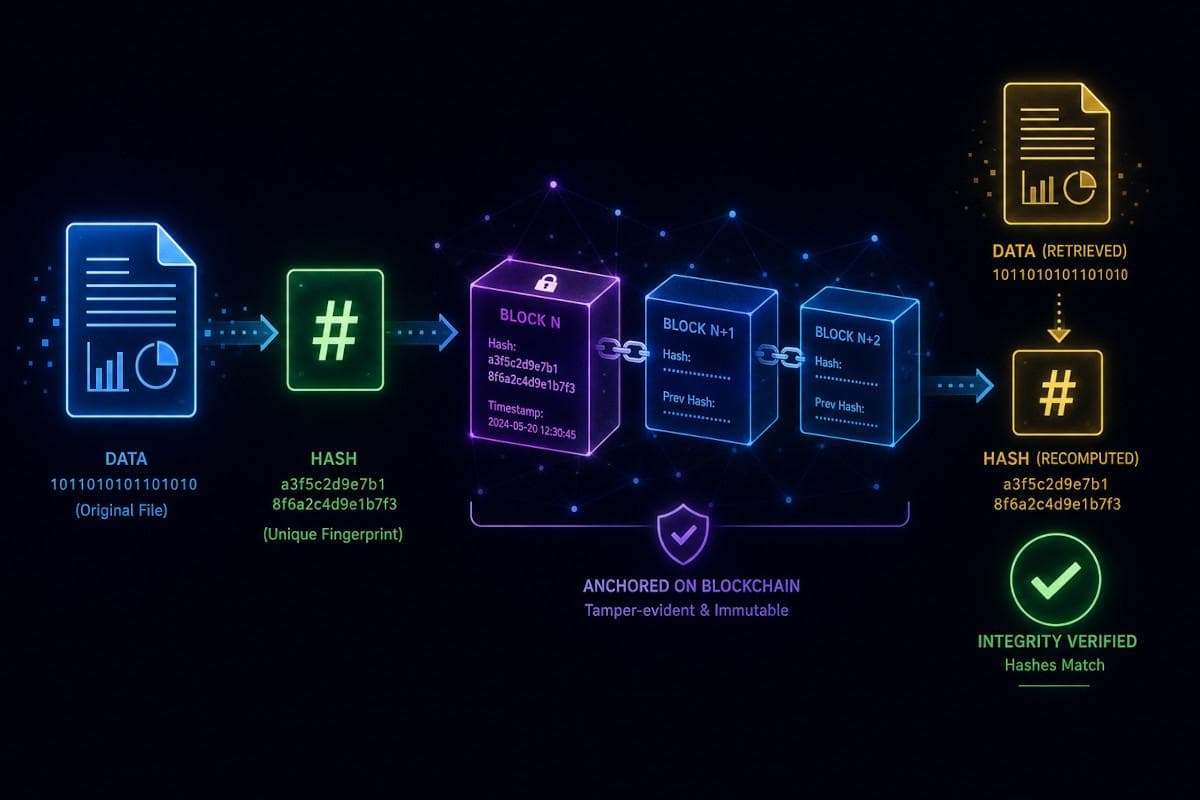
With blockchain-based proof of existence, the underlying record itself is usually not published to the blockchain. Instead, a cryptographic hash of the record is generated and anchored to a blockchain transaction. Because the blockchain is append-only and timestamped, that anchored hash becomes strong evidence that the record existed in that exact form when the anchor was recorded.
In simple terms:
- the file is hashed
- the hash is anchored to the blockchain
- the blockchain records the anchor at a point in time
- later, the file can be hashed again and compared to the anchored value
If the hashes match, that supports both proof of existence and proof of data integrity.
How Blockchain Technology Supports Data Integrity Verification
A hash is a cryptographic fingerprint derived from data using an algorithm such as SHA-256.
Even the smallest change to a file produces a materially different hash. That makes hashing highly effective for integrity verification. Blockchain technology strengthens that model by adding an external, timestamped, and independently reviewable reference point.
A blockchain-anchored integrity workflow typically looks like this:
- A document or record reaches a relevant event, such as upload, finalization, signature, filing, or archival.
- The system generates a cryptographic hash of the file or canonical record representation.
- That hash, or a batch commitment derived from multiple hashes, is anchored to a blockchain.
- The transaction ID, timestamp, block reference, and verification metadata are preserved.
- Later, the record can be rehashed and compared with the anchored proof.
If the recalculated hash matches the anchored hash, the record is shown to be unchanged since anchoring.
Proof of Data Integrity Without Storing Personal Data On-Chain
One of the most important points is that you do not need to store the underlying document or personal data on-chain in order to prove integrity.
In most cases, that is the better design.
This is particularly relevant in light of European Data Protection Board (EDPB) Guidelines 02/2025 on processing of personal data through blockchain and, which emphasize that blockchain solutions must still comply with core data protection principles. Those principles include data minimization, purpose limitation, storage limitation, privacy by design, and careful assessment of roles and responsibilities.
For document integrity use cases, that points toward a more privacy-conscious architecture:
- the file remains off-chain
- personal data remains in controlled application storage
- only a hash or other commitment is anchored
- verification metadata is retained separately within the platform
That approach is generally much easier to justify from a privacy and governance perspective than writing raw documents or identifiable content to an immutable ledger.
Why Blockchain-Anchored Hashes Are Stronger Than Internal Hash Checks Alone
Internal hash verification is useful, but if both the file and the stored hash sit inside the same environment, someone with sufficient access could theoretically alter both.
Blockchain anchoring strengthens the evidentiary model by adding an independent verification layer.
That matters because the blockchain record is:
- append-only
- independently timestamped
- externally verifiable
- difficult to alter retroactively
So instead of saying, “Trust our internal database,” the platform can say:
Here is the file hash, here is when it was anchored, here is the verification proof, and here is the blockchain reference.
That is a stronger position for audits, disputes, and evidentiary review. In this way, blockchain technology helps move integrity claims from internal assertion to independently reviewable proof.
Proof of Existence and Proof of Integrity for Legal and Compliance Records
For legal tech, governance, and compliance use cases, blockchain-anchored hashes are especially useful because records often need to withstand later scrutiny.
Common examples include:
Contracts and signed documents
To show that the finalized version existed in a specific form at a given time.
Regulatory and compliance records
To support integrity claims around approvals, disclosures, reports, and controlled records.
Corporate governance materials
To preserve trust in board documents, resolutions, registers, and internal approval records.
Evidence and investigation files
To support tamper-evident handling and stronger chain-of-custody narratives.
Archived digital records
To show that preserved records remained unchanged after archival.
High-trust document workflows
To reduce disputes over whether a record was modified after issue, acceptance, or preservation.
These are all contexts in which blockchain technology can strengthen the reliability and defensibility of digital records without requiring the records themselves to be placed on-chain.
Lexkeep File Integrity Evidence Report for Verification, Audit, and Evidentiary Support
The practical value is not just in anchoring the hash, but in how the proof is presented.
With Lexkeep, organizations can rely on a seamless File Integrity Evidence Report prepared for:
- verification
- audit
- compliance
- evidentiary support purposes
This helps translate a technical cryptographic process into a clear and usable proof artifact for legal, compliance, audit, and business stakeholders.
A typical report includes:
- the file or record reference
- the integrity status
- the cryptographic hash value
- the hashing method used
- anchor date and time
- blockchain transaction reference
- a Lexkeep verification link
- a blockchain explorer link
- associated version or record metadata
- report issuance details
This is important because many recipients do not want a deep technical explanation of hashing or blockchain internals. They want a clear, reviewable document that answers:
- what was verified
- how it was verified
- where the proof can be checked
- what the result means
That is exactly the role a well-designed File Integrity Evidence Report can play.
How Lexkeep Verification Links and Blockchain Explorer Links Support Independent Review
An integrity proof is most useful when verification is simple.
A strong workflow allows a reviewer to validate the claim through:
The Lexkeep verification link
This provides a user-friendly verification experience within the platform.
The blockchain explorer link
This provides an external and independently reviewable reference to the anchoring transaction.
That combination gives users both a practical verification interface and an independent evidentiary reference. For auditors, counsel, counterparties, and compliance teams, that improves both usability and trust. It also shows how blockchain technology can be made operational and accessible rather than remaining purely technical.
What Blockchain-Anchored Hashes Actually Prove
It is important to be precise about the claim.
Blockchain-anchored hashing can strongly support the proposition that:
- a record existed in a specific form at or before a given time
- the present file matches the previously anchored hash
- any later alteration would be detectable
- the proof can be independently verified
It does not, by itself, prove that:
- the content was factually true
- the uploader was authorized, unless that is separately controlled
- the source system was uncompromised at the time of creation
- the record is automatically admissible in every legal forum
- a file with the same bytes carries the same legal meaning in every context
So blockchain anchoring works best as part of a broader trust framework that may also include:
- identity controls
- signatures
- audit trails
- versioning
- retention controls
- legal hold capability
- evidentiary exports
This is an important point in understanding the role of blockchain technology: it strengthens proof of integrity and proof of existence, but it does not replace broader legal, governance, or evidentiary controls.
Best Practices for Proof of Existence and Proof of Data Integrity
Organizations implementing this approach should consider several practical best practices.
Hash immutable versions, not changing records
If a record changes over time, hash and anchor each version rather than relying on one mutable object.
Define canonicalization rules
Be precise about exactly what is hashed so later verification remains reliable.
Preserve proof metadata
Store the algorithm used, timestamps, transaction reference, and version identifiers.
Keep personal data off-chain wherever possible
This is both operationally sensible and more aligned with privacy-conscious blockchain design.
Make verification understandable
Proof is most effective when it can be reviewed by non-technical stakeholders through a clear report and verification interface.
Integrate integrity proof into governance workflows
Integrity evidence becomes more useful when tied to retention, audit, chain-of-custody, and records management processes.
These practices help ensure that blockchain technology is used in a way that is technically sound, operationally useful, and easier to defend.
Why Proof of Data Integrity Matters for Audit, Compliance, and Dispute Readiness
Organizations are increasingly expected to do more than say their records are secure. They must be prepared to show:
- when a record was fixed in a final form
- whether it has remained unchanged
- where the evidence can be reviewed
- how the verification process works
- whether the integrity claim depends only on internal trust
Blockchain-anchored hashes help answer those questions in a credible and independently verifiable way.
For audit teams, they support traceability.
For compliance teams, they support control evidence.
For legal teams, they support defensibility.
For counterparties, they support trust.
And when paired with a structured File Integrity Evidence Report, the result is not just technical integrity. It is usable proof. That is where blockchain technology becomes especially valuable in practice.
Conclusion
Blockchain technology offers a practical way to strengthen trust in digital records by supporting proof of existence, proof of data integrity, and independent verification.
By anchoring a cryptographic hash of a file instead of the original file, organizations can support:
- proof of existence
- proof of data integrity
- independent verification
- audit readiness
- evidentiary support
The strongest approach is usually not to place records themselves on-chain, but to keep the record controlled off-chain, anchor the integrity proof on-chain, and provide clear verification through the platform and independent blockchain references.
With Lexkeep, that approach can be operationalized through seamless integrity verification and a File Integrity Evidence Report designed for verification, audit, compliance, and evidentiary support purposes, including both a Lexkeep verification link and a blockchain explorer link for independent review.
In high-trust environments, that is what matters most: not just storing digital records, but being able to prove they remain intact.
Frequently Asked Questions
01What is off-chain data?
Off-chain data is information that is not stored on the blockchain. In most document workflows, the actual file stays in your normal storage system, document platform, or database rather than being uploaded to the blockchain.
This is usually the practical approach because it helps keep files private, manageable, and under your control.
02What is on-chain data?
On-chain data is information that is recorded on the blockchain. In many integrity and verification systems, this is not the full document itself but a hash, timestamp, or proof record linked to the file.
In simple terms, the file stays off-chain, while the proof about that file is recorded on-chain.
Can't find what you're looking for? Browse more FAQs or contact us for further assistance.