
Secure Legal Files with Blockchain & Encryption
Published on: (Updated on: )
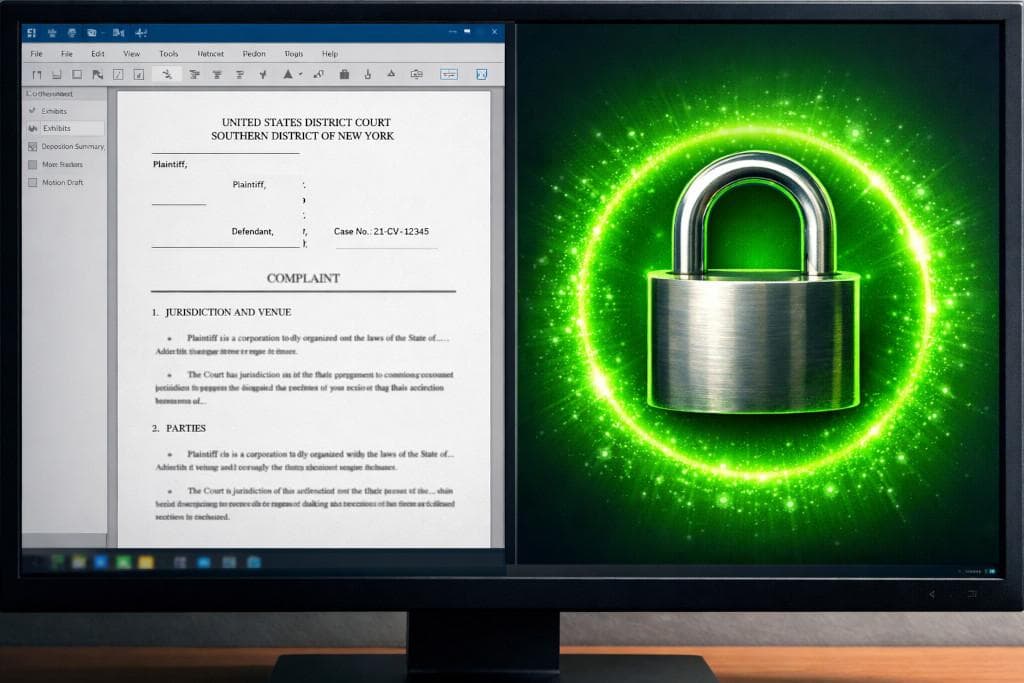
Creating Solid Tamper‑Evident Proof for Legal Files
Most law firms and in‑house teams already store documents in “the cloud.”
What’s changing is the expectation that you can prove exactly what existed, in what form, at what time—without relying solely on your own word or your own servers.
Regulators, courts, and counterparties are increasingly skeptical of internal logs and self‑hosted systems. That’s where cryptographic proofs, blockchain anchoring, and stronger encryption start to matter.
This article looks at why legal teams are moving to crypto‑verified record‑keeping, and how we designed Lexkeep to meet real evidentiary and compliance needs rather than just adding “blockchain” as a buzzword.
The Problem: “We Say This Is the Original” Isn’t Enough
Traditional DMS or cloud storage is good at access and collaboration. It is much weaker at provability.
Typical pain points:
- Authenticity challenges
Opposing counsel questions whether a document, email, or recording has been edited. You produce logs and screenshots; they respond, “Those are your own systems. How do we know?” - Timing disputes
You need to show that a draft, NDA, research result, or design file existed by or before a certain date. Internal timestamps help—but again, they’re under your control. - Chain of custody gaps
In criminal, regulatory, or internal investigations, you must show who touched what, when. Manual logs and spreadsheets are fragile and easy to contest.
Courts do admit electronic evidence, but in many jurisdictions the weight given to that evidence depends heavily on the robustness and independence of your record‑keeping processes.
What “Blockchain Anchoring” Actually Does (and Doesn’t Do)
“Blockchain” is often oversold. So, first: what Lexkeep does not do.
- We do not store your documents, videos, or audio on a public blockchain.
- We do not make your confidential evidence publicly readable.
- We do not rely on speculative tokens or DeFi infrastructure.
Instead, Lexkeep uses a simple, law‑friendly pattern:
- You upload a file (PDF, DOCX, JPG, WAV, MP4, etc.) to Lexkeep.
- We compute a cryptographic hash of that file (its “fingerprint”).
- We anchor that hash on the Ethereum blockchain in a transaction that contains:
- The hash (not the file),
- A block timestamp,
- A reference that you can later cite.
Because Ethereum is a global, append‑only ledger, that fingerprint and its timestamp become:
- Immutable: once recorded, nobody—not even us—can alter or delete it.
- Publicly verifiable: anyone can independently verify that a given file’s hash matches what was anchored.
- Time‑stamped: the block time provides strong evidence that the file (or at least its exact contents) existed by that time.
In evidentiary terms, you gain a robust, independent proof of existence and integrity without exposing the underlying content.
Encryption: At Rest, In Transit, and (If You Choose) End‑to‑End
For legal teams, confidentiality is non‑negotiable. Lexkeep is built around three layers:
- AES‑256 Encryption at Rest
- All files are stored off‑chain in secure cloud storage with AES‑256 encryption at rest.
- This is the same class of symmetric encryption widely used in regulated industries and considered strong against foreseeable threats.
- Transport Security
- All communication between your devices and Lexkeep runs over TLS, protecting data in transit.
- Optional End‑to‑End Encryption (E2EE)
- You can choose to encrypt files on your device before upload.
- In that mode, Lexkeep never sees the plaintext—we store only ciphertext.
- Decryption passphrases or keys used for end‑to‑end encryption remain under your control and that of explicitly authorised recipients; Lexkeep does not have access to them.
E2EE is particularly relevant for:
- Privileged case files and strategy documents
- Witness interviews and internal investigation materials
- Highly sensitive regulatory and corporate matters
You effectively get a second layer of protection: even if storage were compromised, the attacker would see only encrypted blobs.
Cohorts: Controlled Collaboration for Matters, Deals and Investigations
Evidence is rarely handled by a single person. It moves between:
- Lead counsel and co‑counsel
- Internal teams and external experts
- Clients, regulators, and opposing parties
Email attachments and ad‑hoc cloud folders make access control difficult to manage and harder to prove later.
Lexkeep introduces “cohorts”—structured collaboration spaces where you can:
- Group relevant parties by matter, deal, investigation, or business unit
- Assign granular roles (view, upload, manage)
- Share E2EE‑protected files via secure links, even with external users who don’t have accounts
- Update or revoke access as the matter evolves
For each upload, Lexkeep maintains a cryptographic audit trail: who anchored what, when, and (optionally) from where. When challenged, you’re not relying on manually updated logs; you have an automated, verifiable record.
How This Maps to Evidence and Compliance Requirements
Different jurisdictions use different language—“electronic evidence,” “digital evidence,” “computer‑generated records”—but the core questions are often similar:
- Is this what you say it is? (authenticity / integrity)
- Did it exist when you say it did? (timing / priority)
- Who had access, and what did they do? (chain of custody)
- Did you handle it in a way that complies with data‑protection and sector rules? (compliance)
Lexkeep’s design is aimed at giving you credible answers:
- Authenticity & Integrity:
- File hashes anchored on Ethereum; any bit‑level change produces a different hash.
- One‑click File Integrity Certificates present this in a human‑readable way for courts, regulators or counterparties.
- Timing / Priority:
- Blockchain block timestamps provide a strong, independent indicator that a file existed “by or before” a given time.
- Chain of Custody:
- Uploads and key actions generate a tamper‑evident audit trail tied to your account or cohort.
- Compliance:
- AES‑256 encryption at rest; optional E2EE; EU‑based data hosting; WORM storage and defined retention.
- Architecture built to align with frameworks like ISO 27001, GDPR/NDPR, and sector‑specific obligations.
Of course, admissibility always depends on local rules and court practices, and no platform can guarantee that any given judge will accept or reject a particular piece of evidence. What you can do is show you used a robust, independent, technically sound process.
Designed With Legal Insight
Lexkeep wasn’t designed as a generic blockchain tool looking for a use case. It originated from practical problems faced by lawyers handling:
- E‑discovery and digital forensics
- Criminal and administrative proceedings
- IP filings and copyright priority disputes
- NDAs, funding pitches, and confidential deal negotiations
The goal: provide a low‑friction way to anchor trust into everyday legal workflows, without requiring firms to build their own PKI infrastructure or become blockchain engineers.
Where This Is Going
As legal practice continues to digitize, the baseline will shift from:
“We have a copy of this file in our system.”
to:
“We can cryptographically prove this exact file existed by this time,
hasn’t been altered since, and was handled under a controlled process.”
Tools like Lexkeep are one way to get there—by combining encryption, blockchain anchoring and structured collaboration in a form that legal teams can actually use.
If you’re exploring how to strengthen your own electronic‑evidence posture, the next step is simple:
start with one matter, one investigation, or one type of record, and pilot a crypto‑verified workflow from end to end.