
Blockchain-Based Document Verification Software
Lexkeep helps organizations protect document integrity with secure off-chain storage, audit trails, and decentralized blockchain anchoring.
What is blockchain-based document verification software?
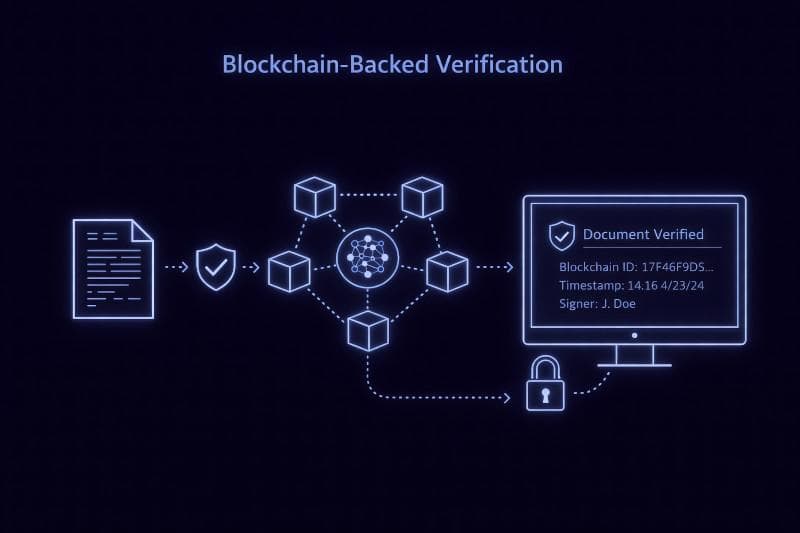
Blockchain-based document verification software helps organizations prove that a document existed in a specific form at a specific time and verify whether it has remained unchanged. Instead of storing the document itself on a blockchain, Lexkeep generates a cryptographic hash of the file and anchors that hash on a decentralized public blockchain, while the original document remains private and stored off-chain.
This approach helps organizations maintain:
- Proof of existence
- Proof of integrity
- Publicly verifiable timestamps
- Tamper-evident preservation
- Stronger audit support
Why blockchain-based document verification matters
Traditional digital storage makes it easy to save documents, but much harder to prove their integrity later. Files stored in cloud drives, shared folders, or email systems can be overwritten, deleted, renamed, or challenged without an independent way to verify what existed at a specific time.
Lexkeep helps solve this by combining secure storage with cryptographic hashing, audit trails, and decentralized blockchain anchoring. The result is a more reliable way to maintain documents that are verifiable, time-stamped, and tamper-evident.
When stronger document verification becomes necessary
Organizations often need stronger document verification when:
- documents may later be challenged
- multiple parties need independent verification
- audit or regulatory scrutiny is likely
- files must be preserved over time without silent alteration
- chain-of-custody narratives matter
- trust cannot depend on one internal system alone
This is where blockchain-based document verification adds value beyond ordinary storage and internal logging.
How blockchain-based document verification software works
Lexkeep helps teams preserve and verify digital documents through a workflow designed for confidentiality, integrity, and verification.
Secure off-chain storage
The original file is stored in secure cloud infrastructure, not on the blockchain.
Cryptographic hashing
Lexkeep creates a unique cryptographic hash of the file. If the file changes, the hash changes.
Decentralized blockchain anchoring
The file hash is anchored on a decentralized public blockchain, creating a publicly verifiable, time-stamped proof of existence and integrity.
Audit trails and verification records
Lexkeep records file activity and supports later verification through audit logs and integrity checks.
Ethereum-based anchoring
Lexkeep currently uses Ethereum for blockchain anchoring to support independent verification without exposing the underlying file contents.
Key features of blockchain-based document verification software
Decentralized blockchain anchoring
Anchor file hashes on a decentralized public blockchain to create public, time-stamped proof of document existence and integrity.
Secure off-chain storage
Keep the original file private in secure storage while using blockchain only for verification.
Publicly verifiable document integrity
Support independent verification of document integrity without relying only on internal systems or a single storage provider.
Tamper-evident verification
Detect whether a file has changed by comparing its current hash against the anchored record.
Audit trails
Maintain a clearer record of file activity, handling history, and verification events.
File Integrity Certificates
Generate File Integrity Certificates to support internal reviews, external reporting, regulatory responses, or evidentiary documentation.
WORM retention and legal hold support
Strengthen preservation controls with workflows that help reduce the risk of overwriting, deletion, or premature disposal.
Encryption and secure access controls
Protect sensitive documents with strong encryption, controlled access, and secure file handling.
What teams can verify later
With Lexkeep, organizations can later verify:
- whether a file matches its original anchored hash
- whether a document existed by a certain date
- whether a document has changed since anchoring
- whether document history supports internal or external review
- whether integrity can be demonstrated independently of the storage environment
This makes the platform especially useful for documents that may later be reviewed, challenged, or relied upon.
Why off-chain storage with blockchain anchoring works better
Storing sensitive files directly on a public blockchain is often impractical and unnecessary. Lexkeep uses a more effective model: private off-chain storage for confidentiality, combined with decentralized blockchain anchoring for public verification.
This approach helps organizations:
- keep file contents private
- avoid exposing sensitive data publicly
- maintain scalable storage workflows
- preserve independent proof of integrity
- support verification without sacrificing confidentiality
It is a practical way to combine privacy, usability, and verifiable document integrity.
More than internal audit logs
Internal audit logs are useful, but they are still part of the same system being relied on. Lexkeep adds an external, independently verifiable layer of proof.
That means organizations are not relying only on:
- internal timestamps
- internal storage history
- one vendor’s records
- one administrator’s controls
For high-value documents, this can provide a stronger basis for trust, review, and dispute readiness.
Built for high-value documents
Not every file needs blockchain-based verification. This capability is most valuable for documents where authenticity, timing, and integrity may later matter to third parties.
Examples include:
- title and registry records
- executed agreements
- official certificates
- tax and finance records
- investigation files
- digital evidence
- board and governance records
For these documents, stronger proof can be just as important as secure storage.
Use cases for blockchain-based document verification software
Land record management
Support stronger integrity, timestamping, and verification for land records and title-related documents, helping reduce risks around tampering, forgery, and record disputes.
Vital records management
Help secure and verify sensitive personal records, such as birth and marriage certificates, through blockchain-backed integrity verification and confidential off-chain storage.
Legal and official documents
Maintain tamper-evident, publicly verifiable records for legal documents, official filings, approvals, and other high-value documents that require stronger proof of integrity.
Public finance and tax records
Support more auditable and transparent document verification for financial and tax-related records where integrity, traceability, and verification matter.
Document authentication
Use blockchain-backed hashing to support fast verification of document authenticity without storing sensitive file contents directly on-chain.
Internal investigations and audit-ready archives
Preserve investigation files, supporting documents, and business-critical records with stronger proof of timing, integrity, and handling history.
Why publicly verifiable document integrity matters
Internal storage logs and timestamps can be useful, but they may not always be enough when documents are challenged. Publicly verifiable document integrity gives organizations a stronger basis for proving that a file existed at a certain time and whether it has remained unchanged.
By anchoring file hashes on a decentralized public blockchain, Lexkeep helps organizations maintain verification that does not depend solely on internal systems, a single vendor, or private timestamps. This can be especially valuable when documents are reviewed by auditors, regulators, counterparties, investigators, or courts.
File Integrity Certificates for clearer verification
Lexkeep’s File Integrity Certificates help teams document and present document verification in a clearer and more usable format. Instead of relying only on internal logs or technical explanations, teams can generate certificates that support internal reviews, external reporting, evidentiary documentation, and audit preparation.
This makes stronger document verification more practical for organizations that need not only integrity controls, but also a clearer way to communicate proof.
Confidential off-chain storage by design
Lexkeep does not store the actual file on-chain. Only the file’s cryptographic hash is anchored on a decentralized public blockchain.
That means:
- The file content remains private
- Confidential information is not exposed publicly
- Blockchain is used for verification, not public file storage
- Teams can benefit from public proof of integrity without compromising confidentiality
This architecture helps organizations maintain both privacy and verifiability.
Why choose Lexkeep
Many storage tools help teams save files. Lexkeep helps teams prove more about those files later.
Lexkeep combines:
- Secure document storage
- Decentralized blockchain anchoring
- Publicly verifiable document integrity
- Tamper-evident verification
- Audit trails
- File Integrity Certificates
- WORM-style retention
- Legal hold support
- Encryption and secure access controls
This gives organizations a practical way to maintain documents that are not only stored, but also independently verifiable.
Frequently Asked Questions
01Does Lexkeep store documents on the blockchain?
No. Ideally, full documents should not be stored on the blockchain. Only verification data is anchored on a public blockchain.
02What does blockchain anchoring help prove?
Blockchain anchoring helps support proof of document existence, integrity, and timestamp verification.
Can't find what you're looking for? Browse more FAQs or contact us for further assistance.