
Blockchain Academic Credentials Verification
Published on: (Updated on: )
Academic credentials are meant to prove achievement, identity, and qualification. But in practice, verifying certificates, transcripts, diplomas, and other academic records can be slow, fragmented, and vulnerable to fraud.
Institutions may rely on manual checks, paper archives, email confirmations, or disconnected databases. Employers, licensing bodies, scholarship providers, and public authorities often face delays when trying to confirm whether a credential is genuine. At the same time, forged certificates and altered academic records continue to create serious trust and compliance problems.
This is where blockchain academic credentials verification is becoming increasingly relevant.
Blockchain does not replace the academic record itself. But it can help institutions and verifiers maintain stronger proof that a credential existed in a specific form at a specific time, and whether it has remained unchanged.
What is blockchain academic credentials verification?
Blockchain academic credentials verification is the use of blockchain technology to support the authenticity, integrity, and verifiability of academic records.
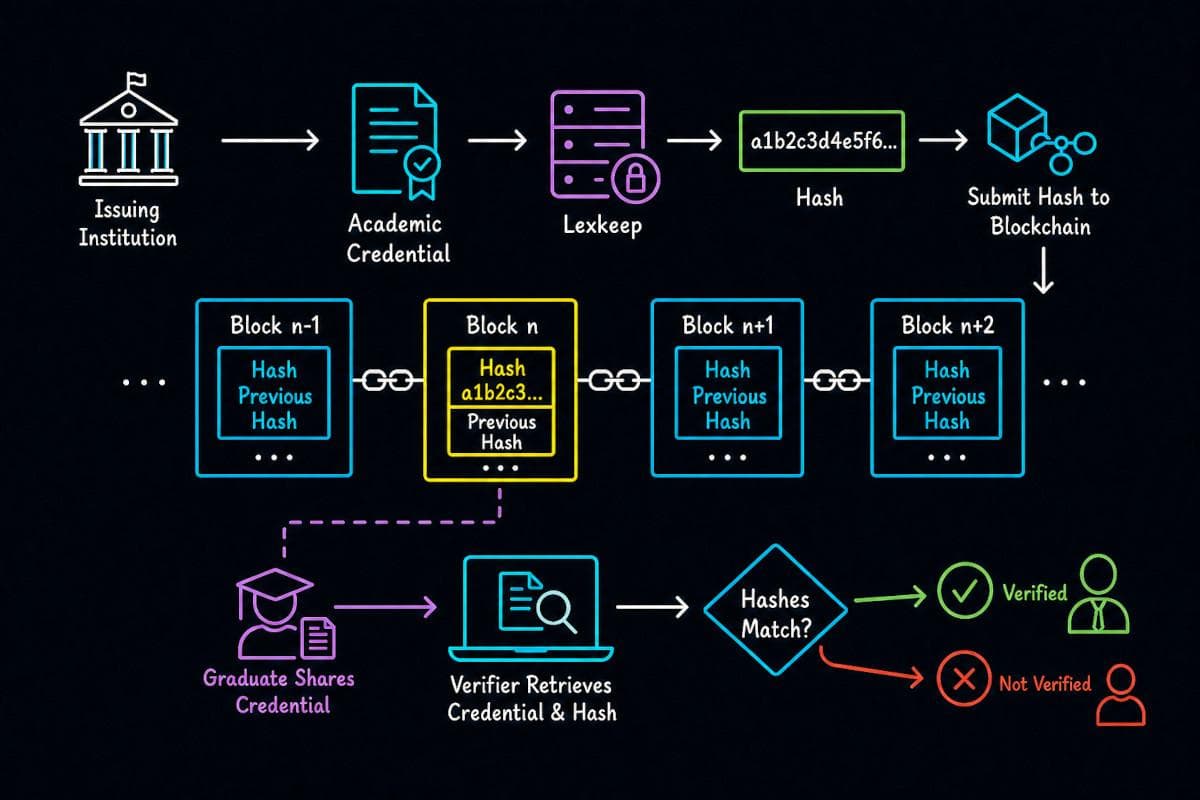
In a typical model, the credential itself is not stored publicly on-chain. Instead, a cryptographic hash of the credential is generated and anchored on a blockchain. The original certificate, transcript, or record remains stored securely off-chain.
Later, the credential can be checked against the anchored hash. If the hashes match, that supports the conclusion that the record has not been altered since it was issued or recorded.
This approach can help institutions and third parties verify:
- proof of existence;
- proof of integrity;
- timestamped issuance;
- tamper-evident preservation; and
- independent verification of academic records.
Why academic credential verification is a challenge
Academic verification often involves multiple pain points:
- forged or altered certificates;
- fake transcripts;
- manual verification requests;
- delays in confirming records;
- inconsistent record formats;
- difficulty verifying older credentials;
- cross-border verification challenges; and
- dependence on one institution’s internal archive or response time.
These issues affect:
- universities and colleges;
- professional schools;
- training institutions;
- employers;
- regulators;
- scholarship bodies;
- immigration authorities; and
- licensing and accreditation bodies.
Where trust in credentials matters, verification needs to be reliable, efficient, and defensible.
How blockchain helps verify academic credentials
Blockchain can strengthen academic credentials verification by helping institutions preserve tamper-evident proof linked to the credential.
A common workflow looks like this:
- A credential is issued or recorded.
- A cryptographic hash of the credential is generated.
- That hash is anchored on a blockchain.
- The original credential remains stored securely off-chain.
- Later, the credential can be hashed again and compared against the anchored record.
If the hashes match, that supports the conclusion that the credential remains unchanged. If they do not match, that may indicate alteration, substitution, or forgery.
This does not mean blockchain alone proves every aspect of authenticity. But it can provide a strong technical basis for verifying whether the credential has retained its integrity.
What blockchain academic credentials verification helps prove
Blockchain-backed verification can help support:
Proof of existence
Showing that a credential existed by or before a certain time.
Proof of integrity
Showing whether the credential has remained unchanged.
Timestamp verification
Supporting a more reliable record of issuance or preservation.
Tamper-evident preservation
Making later changes to the credential more detectable.
Independent verification
Allowing third parties to verify integrity without relying only on manual institutional confirmation.
These benefits are especially useful where credentials may later be reviewed by:
- employers;
- regulators;
- licensing bodies;
- immigration authorities;
- scholarship providers; and
- courts or investigators in fraud-related matters.
Common use cases
Degree and diploma verification
Universities and colleges can support stronger verification of degrees, diplomas, and graduation records.
Transcript integrity
Institutions can help protect transcripts against alteration or substitution.
Professional qualification records
Training institutions and professional schools can strengthen verification of certificates used for licensing or accreditation.
Scholarship and admissions review
Organizations reviewing academic records can verify whether submitted credentials match the original recorded version.
Cross-border credential checks
Blockchain-backed verification can help reduce friction where institutions and verifiers operate across jurisdictions.
Fraud investigations
Where a credential is suspected to be forged or altered, blockchain-backed verification can help support integrity checks and evidentiary review.
Why ordinary digital storage is not enough
A digital file stored in a database or cloud folder may still be:
- edited;
- replaced;
- reissued in altered form;
- challenged later without independent proof; or
- difficult to verify outside the issuing institution.
Traditional storage helps preserve access, but it does not always provide strong independent proof of integrity.
Blockchain-backed verification adds a stronger layer of trust by helping institutions and third parties verify whether a credential matches the original recorded version.
Best practices for blockchain academic credentials verification
To make blockchain useful in academic credential workflows, institutions should follow good record-management practices.
Keep credentials off-chain
Sensitive academic records should usually remain stored securely off-chain. Only the credential hash should be anchored on-chain.
Use consistent hashing and issuance workflows
Verification depends on reliable and consistent technical processes.
Preserve metadata and audit trails
Institutions should maintain records of issuance, updates, access, and verification activity.
Protect confidentiality
Blockchain should support verification without exposing personal academic data publicly.
Make verification easy for third parties
A verification process is only useful if employers, regulators, and other reviewers can use it without unnecessary friction.
How Lexkeep supports academic credentials verification
Lexkeep helps organizations strengthen academic credentials verification through blockchain-backed document verification.
With Lexkeep, institutions and record custodians can:
- generate cryptographic hashes for academic records;
- anchor selected credential hashes on the blockchain;
- maintain tamper-evident proof of existence and integrity;
- preserve records securely off-chain;
- track key record events such as issuance, access, updates; and
- generate File Integrity Certificates for records that may later need to be verified.
Lexkeep also supports secure sharing of academic credentials, helping institutions provide records to employers, regulators, scholarship bodies, and other reviewers without relying on insecure or uncontrolled file transfer methods.
This can help universities, training institutions, scholarship bodies, employers, and regulators maintain stronger trust in academic records and reduce the risks associated with forged or altered credentials.
Conclusion
Academic credentials only serve their purpose when they can be trusted.
Blockchain academic credentials verification helps institutions and third parties move beyond manual checks and ordinary storage by adding stronger proof of existence, integrity, and timing. For organizations dealing with forged certificates, altered transcripts, or slow verification processes, that can make a meaningful difference.