

Court Diary Software with Cause List Reminder
Published on:
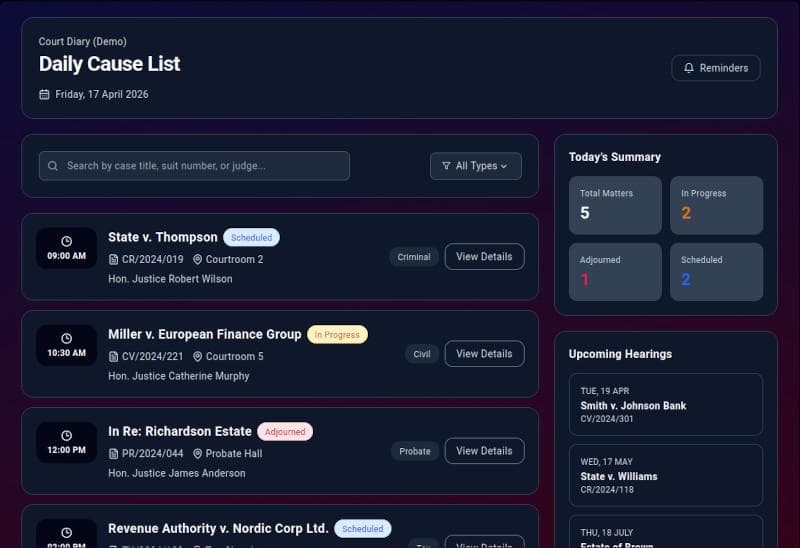
Legal teams handle a constant flow of hearings, filings, appearances, adjournments, service deadlines, and follow-up tasks. When these are tracked in a physical diary, important updates can be missed, shared too late, or forgotten altogether.
A digital court diary offers a more reliable way to manage court activity. It helps law firms and legal departments improve court date tracking, stay on top of legal deadline reminders, and coordinate court appearances across the team. For firms managing active litigation, it also works as a practical litigation calendar and law firm calendar in one place.
Lexkeep Digital Court Diary helps legal teams replace manual diary processes with a centralized system for scheduling, reminders, and matter-linked court management.
Why physical court diaries create problems
A physical court diary may feel simple, but it creates real challenges for busy legal teams.
First, it does not support automatic updates across the team. If one lawyer records a new hearing date or filing deadline, others may not see it immediately. This can lead to missed communication, duplicated effort, and scheduling conflicts.
Second, a physical diary does not provide automated reminders. Counsel often need to check entries manually every day, only to discover that a deadline is close or has already passed. This is a common problem with motion filing, service of process, court appearances, and other time-sensitive litigation tasks.
Third, physical diaries are harder to search and maintain over time. Notes may be incomplete, difficult to read, or spread across multiple books, calendars, and personal records. That makes it harder to track matter history or confirm what was scheduled, updated, or done.
Why a digital court diary works better
A digital court diary gives legal teams a shared and structured way to manage court schedules. Instead of relying on handwritten notes or disconnected calendars, everyone works from the same source of truth.
This is where court diary software and legal diary software become valuable. A good system does more than record dates. It supports:
- court date tracking
- court appearance tracking
- legal deadline reminders
- matter-linked scheduling
- team-wide calendar visibility
For litigation-focused teams, this also creates a more effective litigation calendar. Partners, associates, and support staff can see upcoming hearings, filing deadlines, and assigned responsibilities without relying on manual updates.
Better court date tracking across matters
Court date tracking is one of the most important parts of litigation management. Missing a hearing or filing date can affect case strategy, client confidence, and professional credibility.
A digital court diary makes court date tracking easier by keeping all court events in one searchable system. Legal teams can quickly review hearings, adjournments, filing dates, and next steps across multiple matters.
This is especially useful for firms handling a high volume of cases in different courts. A centralized litigation calendar helps teams plan ahead, avoid clashes, and allocate work more effectively.
Court appearance tracking improves coordination
Court appearance tracking is about more than recording a date. Legal teams also need to know:
- which matter is involved
- which counsel is assigned
- the court venue
- what documents are needed
- what preparation must be completed
A physical diary rarely captures all of this in a way that is easy to share. Digital court diary software makes court appearances easier to track because each event can be linked to the relevant matter, client, and legal team.
For firms that need a dependable law firm calendar, this shared visibility helps reduce double-booking, missed appearances, and last-minute confusion.
Legal deadline reminders reduce avoidable mistakes
One major weakness of a physical diary is the lack of legal deadline reminders. Important dates often depend on someone remembering to check the diary at the right time.
Legal diary software solves this by helping teams stay ahead of deadlines for filings, responses, service obligations, compliance steps, and follow-up actions. Instead of reacting late, lawyers and support staff can prepare earlier and work more confidently.
This reduces avoidable mistakes and supports a more disciplined legal workflow.
Cause list reminders support daily preparation
Daily court preparation often depends on knowing what appears on the cause list, where matters are listed, and what needs attention before the court day begins.
Without a structured system, this information may be checked too late or shared inconsistently. A digital court diary with cause list reminders helps legal teams stay prepared by connecting scheduled matters with upcoming court activity.
This gives the team better visibility into:
- what is coming up
- where the matter is listed
- which counsel is responsible
- what preparation is still outstanding
For busy litigation teams, that makes daily planning easier and more reliable.
What to look for in court diary software
Not all court diary software is equally useful for legal practice. A strong system should help teams manage court activity clearly and collaboratively.
Look for features such as:
- a digital court diary for hearings, filings, adjournments, and appearances
- court date tracking across multiple matters
- court appearance tracking linked to assigned counsel
- legal deadline reminders for key litigation tasks
- a shared litigation calendar for team visibility
- law firm calendar functionality for scheduling across teams
- matter-linked updates and scheduling history
- cause list reminders for court-day preparation
These features help turn diary management into a more reliable legal workflow.
How Lexkeep helps legal teams stay organized
Lexkeep Digital Court Diary helps law firms and legal departments manage court schedules with less manual effort and better visibility.
It combines the benefits of a digital court diary, court diary software, legal diary software, litigation calendar, and law firm calendar in one system.
With Lexkeep, legal teams can:
- record hearings, filings, appearances, adjournments, and next steps
- improve court date tracking across active matters
- support court appearance tracking with better team visibility
- receive legal deadline reminders for important tasks
- use cause list reminders to prepare ahead
- connect every court event to the relevant matter and legal team
- replace scattered notes and manual diary entries with a centralized workflow
A practical shift for modern legal teams
Moving from a physical diary to a digital court diary is not just about convenience. It is about reducing risk, improving coordination, and making court management easier across the team.
As legal work becomes more collaborative, manual diary systems become harder to maintain. Court diary software gives firms a better way to manage hearings, deadlines, appearances, and daily court preparation.
For law firms and legal departments that want stronger court date tracking, better legal deadline reminders, and a more dependable litigation calendar, a digital court diary is a practical next step.
If your team still relies on handwritten entries, scattered calendars, or manual follow-ups, it may be time to adopt a system built for modern legal work.