
How to Create Copyright Evidence in Few Minutes
Copyright protection is automatic in many jurisdictions. The moment an original work is created and fixed in a tangible form—lyrics, a script, a beat, a photograph, a video, a design draft—copyright typically arises without registration.
In practice, however, clients rarely come to lawyers because they doubt that copyright exists. They come because they need something more practical:
- “How do I prove I created this first?”
- “How do I prove this is the original version?”
- “How do I strengthen my position before I send a takedown or sue?”
This is where a lawyer-led “copyright evidence” workflow becomes valuable.
1) The real problem: proof, not ownership
In infringement disputes, negotiations, and platform takedowns, the contested issues often include:
- Authorship (who created it)
- Timing (when it existed)
- Integrity (whether the file was altered)
- Chain of custody (how it was stored and handled)
Telling a client “copyright is automatic” is legally correct, but disputes often turn on proof of authorship and timing—especially when the defendant claims independent creation or challenges when the work was first created or published.
2) What “copyright evidence” should achieve
A strong evidence pack should help you demonstrate:
- Proof of existence
That the work existed by or before a specific time. - Proof of integrity
That the file you are relying on today is the same file that existed at that earlier time. - A defensible handling process
A clear record of how the file was received, stored, and shared.
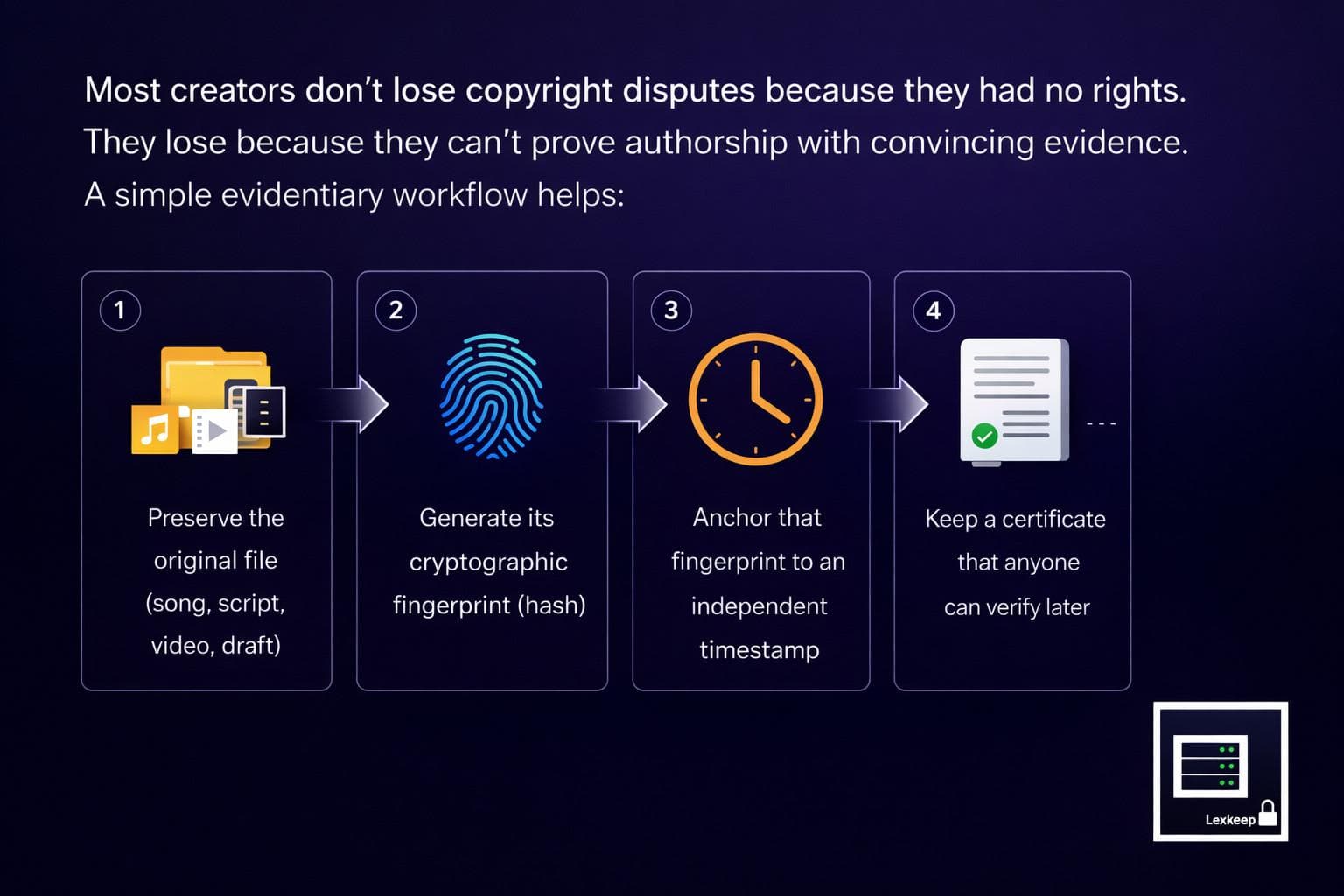
3) The modern method: hashing + independent timestamping
A practical way to strengthen copyright evidence is to:
- compute a cryptographic fingerprint (hash) of the file, and
- anchor that fingerprint to an independent timestamp source
A hash is a unique “fingerprint” of a file. If even one character, pixel, or audio frame changes, the hash changes. This makes tampering detectable.
Independent timestamping matters because internal timestamps (email dates, device metadata, cloud “last modified”) can be challenged as self-generated or editable.
4) How Lexkeep helps lawyers create copyright evidence
Lexkeep is a secure legal document management system (DMS) and case management platform designed for evidence-grade recordkeeping. For copyright evidence, Lexkeep enables a simple workflow:
Step 1: Upload the work (and key versions)
Upload the client’s work in its relevant form:
- lyrics or scripts (PDF/DOCX)
- audio (WAV/MP3)
- video (MP4)
- design drafts (PNG/JPG/PSD exports)
- source code archives (ZIP)
Where appropriate, upload multiple versions (draft → final). Each version can be anchored separately.
Step 2: Create a tamper-evident fingerprint
Lexkeep generates a cryptographic fingerprint of the file using Keccak‑256 (Ethereum-native hashing). Any later change to the file will produce a different fingerprint.
Step 3: Anchor the fingerprint on blockchain
Lexkeep anchors the fingerprint on Ethereum, creating an immutable record tied to a blockchain timestamp. This supports a clear claim:
This exact file existed by or before this time, and any alteration would be detectable.
Step 4: Store securely and control access
Files are stored in encrypted cloud storage (AES‑256 at rest). For highly sensitive or unreleased works, Lexkeep offers optional end‑to‑end encryption (E2EE) so the file is encrypted on the client’s device before upload and only authorised recipients can decrypt it.
Step 5: Generate a File Integrity Certificate
Lexkeep can generate a File Integrity Certificate containing:
- the file hash (Keccak‑256)
- the blockchain anchoring reference (transaction)
- relevant timestamps and verification details
This gives lawyers a client-ready artifact that can be used in:
- licensing negotiations
- takedown requests
- cease-and-desist letters
- pre-action correspondence
- litigation preparation
5) Packaging this as a lawyer service: “Copyright Evidence Pack”
Lawyers can productize this into a fixed-fee add-on for creators and rights holders:
Copyright Evidence Pack (example deliverables)
- anchoring of the final work + key drafts
- secure storage in a matter workspace
- File Integrity Certificates for each anchored version
- a short memo explaining what the proof shows (and what it does not)
- optional secure sharing with collaborators, labels, or publishers
This is often more valuable to clients than generic advice, because it produces a tangible output that strengthens enforcement readiness.
6) What this does not do (important)
To avoid mixed signals with clients:
- It is not copyright registration.
- It does not prevent copying or plagiarism.
- It does not guarantee a court outcome or platform decision.
What it does is strengthen the evidentiary position by making integrity and timing easier to prove and harder to dispute.
Conclusion
Copyright may be automatic, but proof is not. A lawyer-led workflow that combines secure storage, hashing, independent timestamping, and clear certificates can materially improve a client’s ability to enforce rights and resolve disputes.
Lexkeep makes this workflow simple: upload the work, anchor its fingerprint on blockchain, store it securely (with optional E2EE), and generate a File Integrity Certificate you can use when it matters.