
Blockchain Record-Keeping: Tamper-Evident Proof
Published on: (Updated on: )
Traditional digital storage makes it easy to save records, but much harder to prove their integrity later. Files stored in cloud drives, shared folders, or email systems can be overwritten, deleted, renamed, or challenged without an independent way to verify what existed at a specific time.
For legal and compliance teams, that creates risk. In disputes, investigations, audits, and regulatory reviews, it is often not enough to say a record was stored. Teams may also need to show that the record existed by a certain date, remained unchanged, and can be verified independently.
Lexkeep helps solve this through blockchain record-keeping. By anchoring a document’s cryptographic hash on a public blockchain while keeping the file itself private and stored off-chain, Lexkeep helps organizations maintain tamper-evident, time-stamped, and independently verifiable records. For teams looking for a more reliable alternative to ordinary digital storage — or searching for tamper-proof record keeping — this provides a more accurate and defensible way to prove integrity over time.
Why traditional digital record-keeping falls short
Most organizations rely on cloud storage, shared drives, and email to manage business-critical records. While these tools are convenient, they often fall short when stronger proof of integrity is needed.
Common weaknesses include:
- mutable storage, where files can be overwritten, replaced, or deleted
- centralized timestamps that may be questioned or manipulated
- weak audit trails for litigation, investigations, or regulatory scrutiny
- limited ability to prove a file existed at or before a specific time
- dependence on a single storage provider for trust and verification
Modern record-keeping requires more than storage. It requires confidentiality, integrity, and verifiable timelines.
Tamper-Proof vs Tamper-Evident Records
Teams looking for stronger digital record protection may search for tamper-proof record keeping. In practice, tamper-proof and tamper-evident describe different but related approaches to record integrity.
A tamper-proof system is designed to prevent unauthorized changes from being made. A tamper-evident system is designed to reveal whether a record has been changed and to support independent verification of its integrity over time.
Lexkeep supports both stronger preservation controls and verifiable integrity. For legal, compliance, and evidentiary workflows, tamper-evident verification is especially valuable because it helps teams demonstrate that a file existed at a certain time and whether it has remained unchanged over time. Lexkeep supports this through cryptographic hashing, blockchain timestamping, audit trails, and file integrity verification.
Where stronger protection against overwriting or deletion is also needed, Lexkeep’s WORM retention and legal hold workflows help support more defensible record preservation.
What blockchain record-keeping means
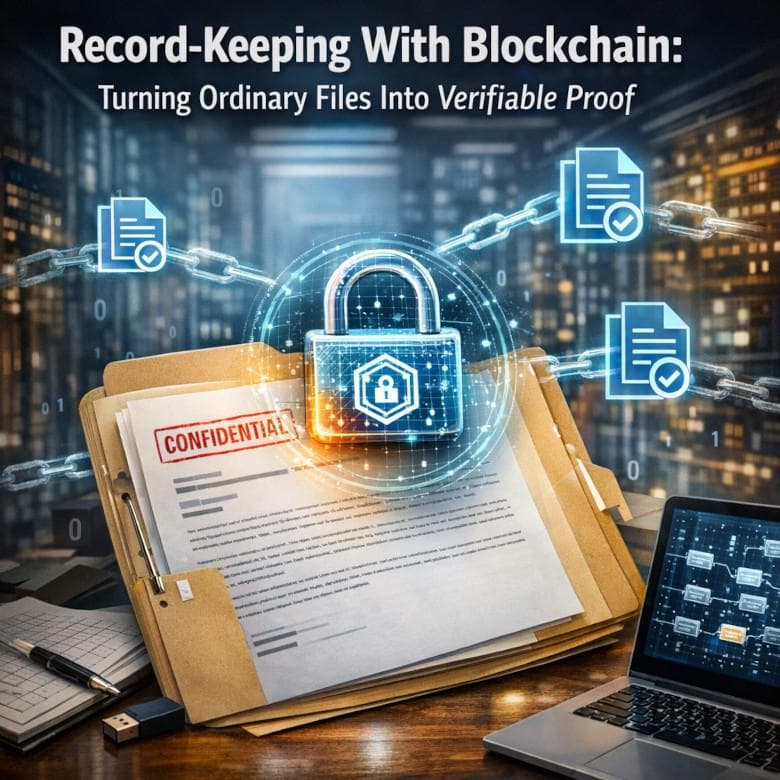
Blockchain record-keeping strengthens digital archives by anchoring a file’s cryptographic hash on an immutable public ledger. This creates a verifiable proof of integrity and proof of existence without exposing the file’s contents.
The process works like this:
Hash the file
A unique cryptographic fingerprint is generated from the file.
Anchor the hash
That fingerprint is written to a blockchain, creating an independent timestamp.
Store the file off-chain
The original file remains private in secure storage, while the blockchain record preserves proof that the file existed in that form at that time.
This means a document can later be verified without storing the document itself on-chain.
What blockchain record-keeping helps prove
For legal and compliance teams, blockchain record-keeping can help support:
- proof of existence — showing a file existed by or before a certain time
- proof of integrity — showing whether a file has been altered
- timestamp verification — supporting reliable timelines for records
- chain of custody narratives — strengthening the handling history of digital evidence
- independent verification — allowing integrity checks without relying only on the storage provider
This is especially useful where records may later be challenged in court, reviewed by regulators, or relied on in internal investigations.
Key benefits of blockchain-based record-keeping
| Challenge | Blockchain record-keeping benefit |
|---|---|
| Tampering | Hash mismatch immediately shows unauthorized edits |
| Timeline disputes | Blockchain timestamp supports “existed by” dates |
| Vendor lock-in | Verification remains possible even if storage systems change |
| Multi-party trust | Different stakeholders can independently verify integrity |
| Evidentiary challenges | Supports stronger proof of integrity and chain of custody |
For teams seeking tamper-proof digital records, these benefits are often what they actually need: a way to detect changes, verify timing, and preserve independent proof.
Practical use cases for legal and compliance teams
Contract record-keeping
Store executed agreements with verifiable hashes to reduce disputes over final versions, execution timing, or later alterations.
Intellectual property record-keeping
Anchor invention disclosures, design files, drafts, datasets, and lab notes to support proof of creation and priority.
Compliance record-keeping
Support retention, audit, and regulatory obligations by combining secure storage with blockchain-backed proof of integrity.
Litigation and digital evidence
Hash pleadings, exhibits, witness materials, audio, and video files to support stronger chain-of-custody and evidentiary narratives.
Internal investigations
Preserve reports, interview records, supporting documents, and sensitive files with stronger proof of timing and integrity.
How Lexkeep automates blockchain record-keeping
Lexkeep combines secure storage with blockchain-backed verification so legal and compliance teams can maintain stronger records without adding unnecessary administrative work.
With Lexkeep, teams can benefit from:
- AES-256 encryption at rest for secure cloud storage
- optional end-to-end encryption for highly sensitive matters
- automatic hashing and Ethereum anchoring on upload
- tamper-evident audit trails for record activity and handling history
- File Integrity Certificates for clients, regulators, opposing counsel, or court bundles
- WORM retention and legal hold features for defensible preservation
This gives organizations a more practical way to maintain secure, verifiable, and audit-ready records.
What Lexkeep does not store on-chain
A common concern with blockchain record-keeping is confidentiality. Lexkeep does not store the actual file on the blockchain. Only the file’s cryptographic hash is anchored on-chain.
That means:
- the document content remains private
- confidential information is not exposed on the blockchain
- the blockchain record is used for verification, not public file storage
This approach helps legal teams gain the benefits of blockchain timestamping and proof of integrity without compromising confidentiality.
Getting started with blockchain record-keeping
A practical way to begin is to start with one high-value workflow, such as:
- executed contracts
- intellectual property records
- compliance files
- investigation records
- digital evidence
From there, teams can:
- upload and securely store the records
- anchor file hashes automatically
- test verification by comparing the file hash to the blockchain record
- document the process in internal record-keeping policies
- expand to other departments once the workflow proves its value
Conclusion
Effective record-keeping is not just about storing files. It is about being able to prove authenticity, integrity, and timing when those records matter most.
Blockchain record-keeping helps turn ordinary digital files into tamper-evident, time-stamped, and independently verifiable records. For organizations looking for a practical alternative to ordinary storage — or searching for tamper-proof record keeping — Lexkeep provides a more accurate and defensible way to maintain proof, audit trails, and stronger digital records without unnecessary complexity.