

Why You Need an Audit Trail for a Provable Simple E-Signature
Published on: (Updated on: )
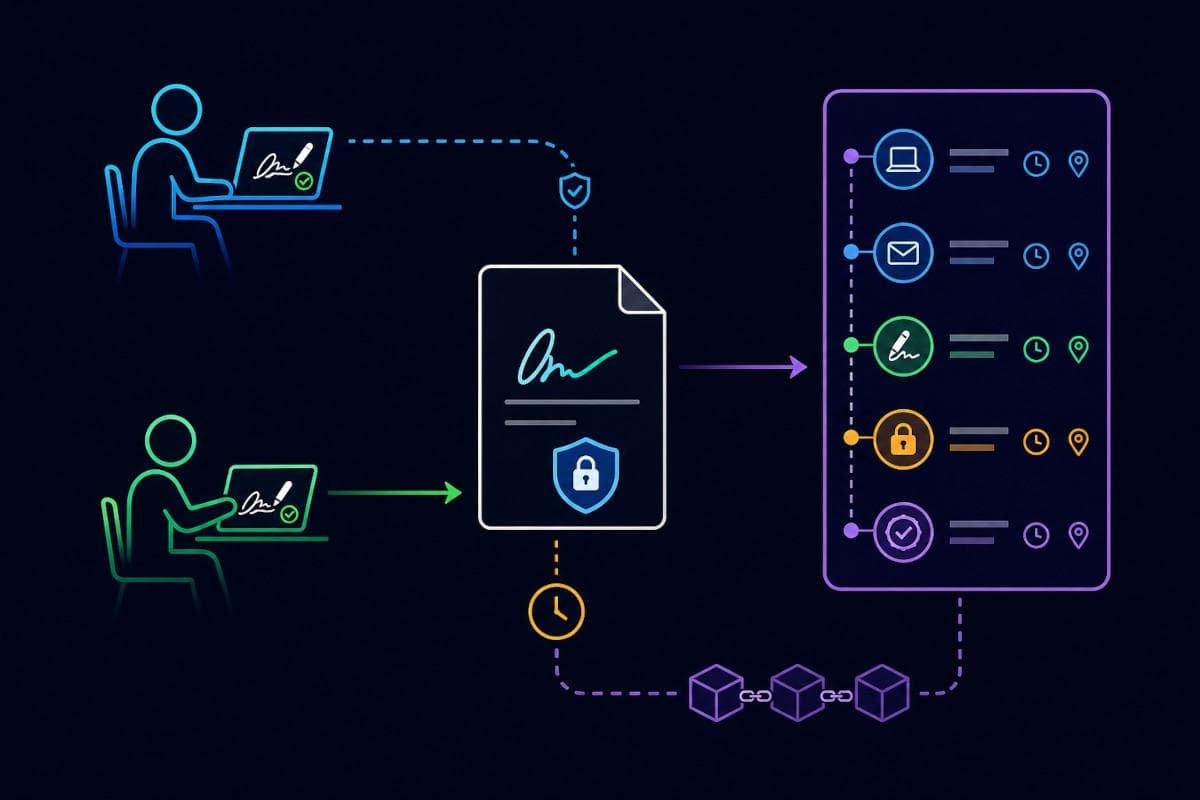
A simple electronic signature is often the fastest, frictionless, and most commercially practical way to sign a document. It may be as straightforward as typing a name, clicking an “I agree” button, pasting a signature image, or taking another electronic step intended to indicate acceptance. For many transactions, that level of simplicity is exactly the point.
But simplicity creates an evidential challenge.
A simple electronic signature usually does not, on its own, provide the same level of built-in technical assurance that may be associated with more advanced electronic signature methods. If a dispute arises, the question is rarely just whether a signature appears on a document. The real questions are more demanding: Who applied it? When? To what exact version of the document? And can you show the record was not altered afterward?
That is where a strong tamper-evident audit trail becomes essential. For a simple electronic signature, the audit trail is often the key evidence that makes the signature not just usable, but provable.
A Simple Electronic Signature Is Easy to Use — and Easy to Challenge Without Good Evidence
The legal usefulness of a simple electronic signature often depends less on the visible signature itself and more on the surrounding evidence. A typed name at the bottom of a contract may indicate intent, but standing alone it may not answer critical questions about attribution and integrity.
For example, if a party later denies signing, you may need to show:
- the identity or likely identity of the signer;
- the email address, phone number, account, or device used in the signing process;
- the date and time of each signing event;
- the exact document presented for signature;
- whether the document changed after signature; and
- the sequence of actions taken before and after signing.
Without that supporting record, a simple electronic signature can become vulnerable to arguments about impersonation, unauthorized access, document substitution, or later alteration.
What a Tamper-Evident Audit Trail Actually Does
A tamper-evident audit trail is more than a generic activity log. It is a structured record of the signing process and the document lifecycle, designed to help demonstrate both authenticity and integrity.
For a simple electronic signature, a strong audit trail should help establish:
1. Who took the signing action
This may include identifiers such as email address, phone number, account credentials, IP address, device information, or authentication steps completed before signing.
2. When the signing action occurred
A reliable timestamp helps place the signature in time and can be critical where timing affects enforceability, authority, or priority.
3. What document was signed
The audit trail should link the signer’s action to a specific version of the document, not just to a file name or transaction label.
4. Whether the document remained unchanged
This is where tamper-evidence becomes especially important. If the signed record is altered after signature, the system should make that detectable.
5. How the signing process unfolded
A defensible audit trail records the sequence: document sent, accessed, reviewed, signed, completed, and stored.
In short, the audit trail helps answer the evidential questions that a simple electronic signature alone may leave open.
Why “Tamper-Evident” Matters More Than a Basic Log
Not every audit log is good enough.
A basic log may record events, but if those records can be edited without detection, they may carry limited evidential weight. A tamper-evident audit trail is stronger because it is designed so that changes to the record, the document, or the signing history can be detected.
That matters because in a dispute, the issue is not only whether you kept records, but whether those records can be trusted.
A strong tamper-evident system may include features such as:
- cryptographic hashing of the signed document;
- sealing or locking the final version after signature;
- immutable or append-only event records;
- secure timestamps;
- version control;
- access logs; and
- evidence of any post-signature modification attempt.
These features do not necessarily transform a simple electronic signature into an advanced electronic signature. But they can significantly improve the ability to prove that the signature event and the signed record are authentic and intact.
For a Simple Electronic Signature, the Audit Trail Often Carries the Evidential Weight
This is the central point: with a simple electronic signature, the visible act of signing is often only one part of the proof. The surrounding audit trail may carry much of the evidential burden.
If a signature is challenged, a court, regulator, counterparty, or investigator may want to know:
- Was the signer properly identified?
- Was the signer given access to the document before signing?
- Did the signer take a deliberate act showing intention?
- Can the signed version be tied to the signature event?
- Is there evidence that the record has remained unchanged?
A strong tamper-evident audit trail helps answer those questions in a coherent and credible way.
Without it, you may still argue that a simple electronic signature is valid. But proving that case becomes harder, more fact-sensitive, and more vulnerable to attack.
Common Risks When the Audit Trail Is Weak
Where a simple electronic signature is used without a strong audit trail, several problems commonly arise:
Identity disputes
A person may deny that they were the one who signed, especially where access credentials were shared, compromised, or loosely controlled.
Integrity disputes
A party may argue that the document presented in evidence is not the same version they saw or accepted.
Process disputes
There may be no reliable record showing whether the signer reviewed the document, received notice, or completed any authentication step.
Timing disputes
If timestamps are incomplete or unreliable, parties may dispute whether the signature was applied before a deadline, before revocation of authority, or before a later amendment.
Evidential weakness
Even where the transaction was genuine, poor records can make it difficult to prove what happened with confidence.
These risks are not theoretical. They are exactly the kinds of issues that become important once a transaction is contested.
A Strong Audit Trail Does Not Replace Good Process — It Supports It
A tamper-evident audit trail is powerful, but it works best as part of a broader signing process.
To make a simple electronic signature more provable, organizations should also think about:
- appropriate signer identification and authentication;
- clear consent to electronic signing;
- clear presentation of the document before signature;
- reliable delivery and access records;
- secure storage of the final signed record;
- retention policies; and
- internal controls over who can send, sign, amend, or access documents.
The stronger the surrounding process, the more persuasive the audit trail becomes.
Why This Distinction Matters: Simple Electronic Signatures Are Not AES
It is important not to blur categories.
A simple electronic signature is often legally useful and commercially sufficient, but it does not necessarily include the enhanced technical controls that may characterize an advanced electronic signature (AES) or other higher-assurance signature framework.
An article about AES would typically discuss issues such as stronger identity binding, cryptographic controls, certificate structures, or signature technologies designed to provide a higher level of assurance by design. By contrast, for a simple electronic signature, the practical legal question is often: what evidence exists around the signature event to make it provable if challenged?
That is why the audit trail is so central here. It helps bridge the gap between a simple act of electronic signing and a more defensible evidential record.
What to Look for in a Signing Platform
If you rely on simple electronic signatures, your signing platform should do more than capture a name or click. It should help you preserve evidence.
Look for features such as:
- detailed event history;
- document hashing or equivalent integrity controls;
- tamper-evident sealing after completion;
- reliable timestamps;
- signer authentication options;
- IP and device capture where appropriate;
- version tracking;
- secure storage and exportable evidence records; and
- controls that make post-signature changes visible.
The goal is not to overcomplicate simple electronic signing. The goal is to ensure that if the signature is ever questioned, you have a credible evidential package to support it.
Blockchain-backed signing can add another layer of proof
Some platforms go a step further in strengthening the evidential value of a simple electronic signature. Lexkeep allows users to anchor the cryptographic hash of the signed copy on the blockchain using Ethereum. This creates an additional, independently verifiable proof that a specific signed document existed in that exact form at a particular point in time — without exposing the document’s contents on-chain.
For simple electronic signatures, this can add another layer of support where the signed record may later need to be relied on in a dispute, investigation, audit, or compliance review. It does not replace the need for a strong tamper-evident audit trail, but it can strengthen the ability to prove the integrity and timing of the signed copy.
Conclusion
A simple electronic signature may be easy to create, but it is not automatically easy to prove.
If you want that signature to stand up when it matters — in a dispute, an audit, an investigation, or a compliance review — you need more than a mark on a document. You need evidence showing who signed, when they signed, what they signed, and whether the record remained intact.
That is why a strong tamper-evident audit trail is not just a technical extra. For a provable simple electronic signature, it is often the foundation of the case.