
Tamper-Proofing Educational Credentials
Protect academic records with verifiable proof of integrity
Educational institutions issue thousands of credentials, transcripts, certificates, and academic records that must remain trusted over time. Whether shared with students, employers, regulators, or partner institutions, these records need to be easy to verify and difficult to falsify.
Lexkeep helps institutions tamper-proof educational credentials by creating verifiable evidence that a document existed in a specific form at a specific time and has not been altered since.
Through cryptographic hashing, blockchain anchoring, and seamless verification workflows, Lexkeep adds an independent integrity layer to digital academic records without exposing the underlying document on-chain.
Why tamper-proof educational credentials matter
Academic records are high-trust documents. But traditional verification methods are often slow, manual, and vulnerable to fraud.
Institutions face growing pressure to prevent:
- fake degrees and forged certificates
- altered transcripts
- disputed issuance dates
- unverifiable digital copies
- costly manual verification requests
- reputational harm from credential fraud
Students and graduates also expect digital credentials that can be shared confidently and verified quickly.
Lexkeep enables institutions to move beyond static PDFs and manual confirmation emails by making credential integrity independently verifiable.
What Lexkeep does
Lexkeep helps institutions prove that educational credentials are authentic and unaltered by generating a cryptographic fingerprint of each document and anchoring that proof to blockchain-backed verification infrastructure.
This means institutions can support:
- proof of existence
- proof of document integrity
- fast verification workflows
- stronger audit and compliance support
- trusted sharing of academic records
The original credential stays under institutional control. Only the cryptographic proof is used for independent verification.
How tamper-proof credential verification works
1. A credential is issued
A diploma, transcript, certificate, or academic letter is finalized by the institution.
2. Lexkeep creates a unique cryptographic hash
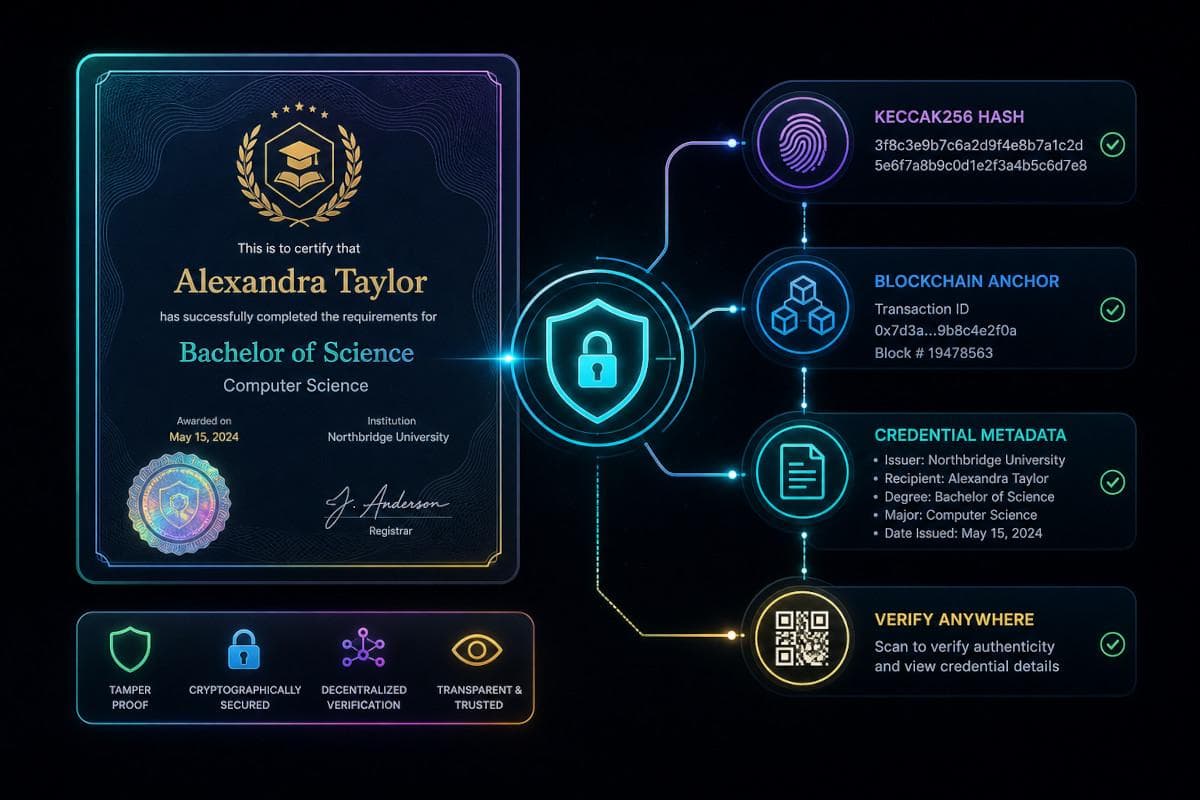
The system generates a hash of the credential, creating a digital fingerprint unique to that exact version.
3. The integrity proof is anchored
That hash, or a batch proof derived from it, is anchored to blockchain-based verification infrastructure.
4. Verification evidence is preserved
The institution can retain the verification metadata, timestamp, anchor reference, and supporting record details.
5. Recipients can verify the credential
A student, employer, regulator, or partner institution can verify that the credential has not been altered by checking the proof through Lexkeep, and where applicable, through a blockchain reference.
Verify educational credentials with confidence
Lexkeep makes it easier to verify academic records without relying entirely on manual back-office confirmation.
Verification workflows can support:
- employers validating candidate credentials
- students sharing trusted academic records
- admissions offices reviewing prior qualifications
- partner institutions checking academic documents
- regulators assessing record integrity
- auditors reviewing issuance controls
This helps institutions reduce administrative burden while improving trust in the records they issue.
Tamper-proof transcripts, diplomas, and certificates
Lexkeep can support integrity verification across a wide range of academic documents, including:
- degree certificates
- diplomas
- transcripts
- statements of results
- enrollment confirmations
- completion certificates
- professional training certificates
- continuing education records
- award letters
- academic reference documents
Where document trust matters, tamper-evident verification adds value.
Reduce academic fraud and forged credential risk
Fraud involving educational records can damage institutional credibility and expose employers and partner organizations to risk.
Lexkeep helps reduce that risk by making unauthorized alterations visible. If a document is changed after issuance, its cryptographic fingerprint no longer matches the preserved integrity proof.
This makes it easier to identify:
- edited grades
- modified names or award details
- altered completion dates
- fabricated certificates
- substituted document versions
Rather than relying only on visual appearance, institutions and third parties can rely on verifiable integrity evidence.
Support digital credential verification without putting records on-chain
Lexkeep does not require institutions to place full student records or credential content on a blockchain.
That matters for privacy, governance, and data protection.
Instead, the credential remains off-chain and under institutional control, while the integrity proof is anchored for verification purposes. This approach supports a more privacy-conscious model for digital trust.
For institutions considering blockchain-enabled verification, this is an important distinction: the goal is not to publicize academic records, but to make their integrity independently provable.
Built for audit, compliance, and evidentiary support
Educational records often need to stand up to scrutiny long after issuance.
Lexkeep helps institutions maintain stronger evidence for:
- internal record governance
- accreditation and compliance processes
- audit requests
- cross-border recognition workflows
- disciplinary or dispute contexts
- institutional verification policies
Where needed, institutions can rely on a Lexkeep File Integrity Evidence Report prepared for verification, audit, compliance, and evidentiary support purposes.
This can provide a clear proof package that may include:
- document reference details
- integrity status
- cryptographic hash information
- timestamp and anchor reference
- verification link on Lexkeep
- blockchain explorer reference
- report metadata for review and recordkeeping
This turns technical verification into a practical artifact that administrators, auditors, and third parties can understand.
Better credential trust for students, institutions, and employers
For institutions
- reduce manual verification workload
- strengthen trust in issued credentials
- improve fraud resistance
- support digital transformation in records management
For students and graduates
- share credentials with more confidence
- reduce delays in third-party verification
- benefit from more portable trusted records
For employers and recipients
- verify credentials faster
- reduce reliance on informal checks
- improve confidence in academic documents received
Why institutions choose Lexkeep for educational credential integrity
Lexkeep helps bridge the gap between digital issuance and digital trust.
Institutions choose Lexkeep to:
- make credentials tamper-evident
- provide verifiable proof of integrity
- support proof of existence for issued records
- simplify verification for third parties
- preserve privacy by keeping records off-chain
- strengthen compliance and evidentiary readiness
This creates a more trusted framework for issuing and verifying educational credentials at scale.
Use cases
Lexkeep can support institutions and education providers across scenarios such as:
- universities issuing degree certificates
- colleges managing transcripts
- professional training providers issuing completion certificates
- online learning platforms validating course achievements
- certification bodies proving issuance integrity
- schools digitizing academic record verification
- international education workflows requiring trusted document review
Digital credentials are only valuable if they can be trusted.
Lexkeep helps institutions tamper-proof educational credentials with verifiable proof of integrity, streamlined verification, and evidence-ready reporting for academic records that matter.
Frequently Asked Questions
01Does Lexkeep store the full credential on the blockchain?
No. The credential remains off-chain. Lexkeep uses cryptographic proof for integrity verification rather than publishing the full record on-chain.
02Can an employer verify a credential?
Yes. Verification can be performed through a Lexkeep verification workflow, and where applicable, supported by blockchain reference data.
03What happens if a credential is altered?
If the document is changed after issuance, its recalculated hash will not match the original proof, indicating that the file no longer matches the verified version.
04Is this useful only for universities?
No. It can also support colleges, schools, training providers, certifying bodies, and other organizations that issue trusted educational or professional credentials.
Can't find what you're looking for? Browse more FAQs or contact us for further assistance.