
Blockchain Anchoring: What It Is and How It Works
Published on:
As more records move into digital systems, one question keeps coming up across legal, business, government, and compliance environments: how do you prove that a digital document existed in a particular form at a particular time, and that it has not been altered since? Traditional storage systems can preserve access to a file. But access is not the same as integrity. A document may be stored in a cloud drive, document management system, internal server, or archive and still later be challenged. Was it changed? Was it replaced? Did this exact version exist when the organization says it did? Can a third party verify that independently?
These are the kinds of problems blockchain anchoring is designed to help address.
Blockchain anchoring gives organizations a way to create tamper-evident proof linked to a document or record without exposing the document itself on a public blockchain. It is increasingly relevant for legal documents, government records, academic credentials, contracts, compliance files, medical records, intellectual property documentation, and other high-value records where integrity matters.
What is blockchain anchoring?
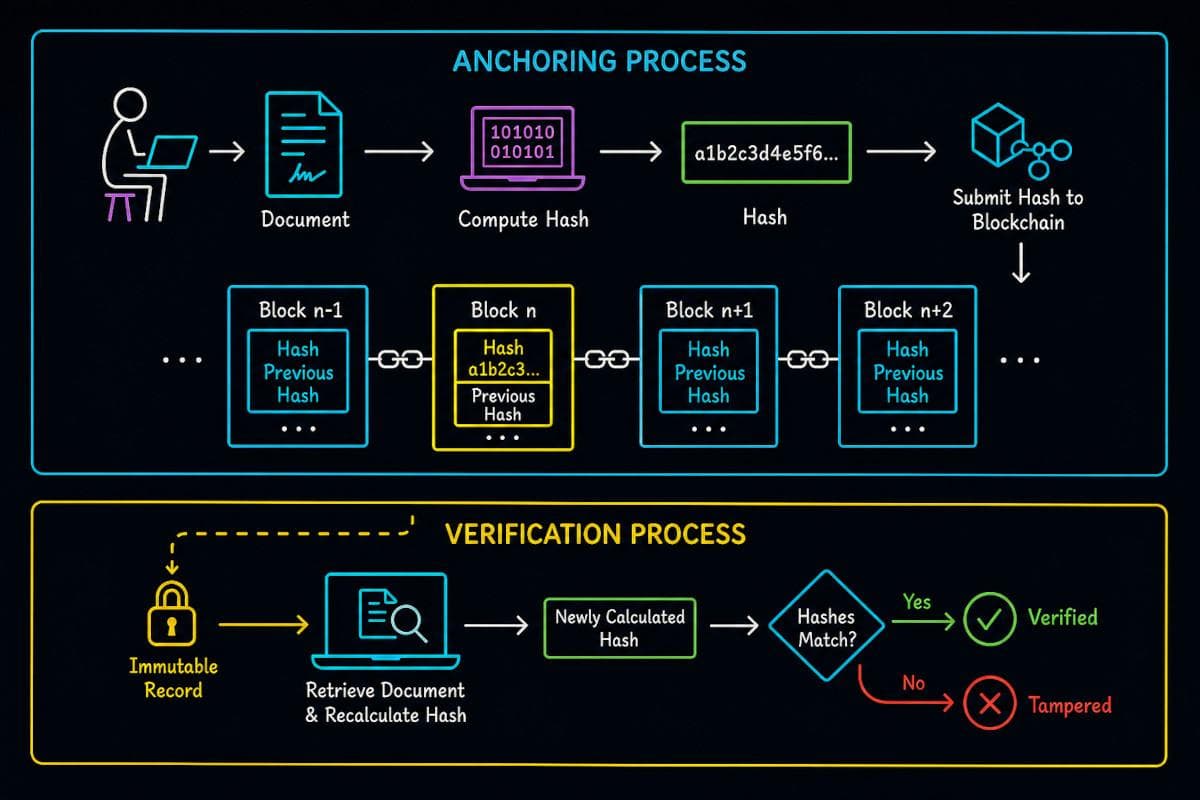
Blockchain anchoring is the process of generating a cryptographic hash of a document, file, or record and recording that hash on a blockchain.
A cryptographic hash is a unique digital fingerprint created from the contents of a file. If even a small part of the file changes, the hash changes too.
In a blockchain anchoring workflow:
- the original document stays stored off-chain;
- a hash of that document is created;
- the hash is anchored on a blockchain; and
- the document can later be verified by comparing its current hash to the anchored one.
If the hashes match, that supports the conclusion that the document has not changed since the time it was anchored.
This means blockchain anchoring is not about publishing the document itself to the blockchain. It is about anchoring proof related to the document’s integrity and existence.
Why blockchain anchoring matters
Digital records are easy to copy, edit, rename, move, and re-save. That flexibility is useful, but it also creates risk.
In many contexts, organizations need more than storage. They need a way to show:
- that a record existed at a certain time;
- that it has not been altered;
- that any later changes are detectable;
- that verification does not depend only on internal trust; and
- that the record can be defended if challenged.
Blockchain anchoring helps provide that additional layer of confidence.
It is especially useful where records may later be relied on in:
- audits;
- investigations;
- disputes;
- regulatory reviews;
- court proceedings;
- procurement oversight;
- licensing decisions; or
- long-term archival preservation.
How blockchain anchoring works
At a high level, blockchain anchoring follows a simple process.
1. A document is created or finalized
This could be a contract, certificate, permit, report, policy document, transcript, or any other digital record.
2. A cryptographic hash is generated
The system creates a hash based on the exact contents of the file.
3. The hash is anchored on-chain
That hash is recorded on a blockchain, creating a timestamped and tamper-evident reference point.
4. The original file remains off-chain
The actual document stays in secure storage, such as a document management system, records repository, or internal archive.
5. The document can later be verified
When needed, the file is hashed again and compared with the anchored hash.
If the hashes match, the file appears unchanged from the version that was anchored. If they do not match, that suggests the file has been altered, replaced, or is not the same version.
What blockchain anchoring helps prove
Blockchain anchoring can help support several important forms of proof.
Proof of existence
It can help show that a document existed by or before a certain time.
Proof of integrity
It can help show whether the document has remained unchanged since anchoring.
Timestamp support
It can provide a reliable reference point for when a document was anchored.
Tamper evidence
It can make later changes easier to detect.
Independent verification
It can allow third parties to verify integrity without relying only on the issuer’s internal word or storage system.
These features are particularly valuable where trust, authenticity, and defensibility matter.
Blockchain anchoring vs storing documents on-chain
This distinction is important.
Many people assume blockchain document systems involve uploading the full document to a blockchain. In most serious recordkeeping contexts, that is not the preferred approach.
Storing documents on-chain
This means placing the actual file or its contents directly on the blockchain. That can create problems involving:
- privacy;
- confidentiality;
- cost;
- scalability;
- data protection obligations; and
- practical document management.
Anchoring documents on-chain
This means storing only the cryptographic hash or proof reference on-chain, while the actual file remains off-chain.
This is usually the more practical and privacy-conscious model for organizations handling sensitive or regulated records.
Why not just use ordinary digital storage?
A file stored in a normal digital system may still be:
- edited without clear evidence;
- replaced by another version;
- challenged later;
- dependent on one institution’s internal controls; or
- difficult for outsiders to verify independently.
Traditional storage is important, but it does not always provide strong independent proof of integrity.
Blockchain anchoring adds a separate verification layer that helps organizations show that a file matches a previously recorded version.
Common use cases for blockchain anchoring
Blockchain anchoring can be applied across many sectors.
Legal documents
Contracts, affidavits, legal notices, filings, and evidentiary records may benefit from stronger proof of integrity and timing.
Government records
Permits, licenses, procurement files, land records, policy approvals, and regulatory records often require strong defensibility and audit readiness.
Academic credentials
Certificates, diplomas, transcripts, and training records can be protected against forgery or alteration.
Compliance documentation
Organizations can anchor policies, reports, disclosures, and internal compliance records to support audit and regulatory review.
Medical and health records
Where legally and operationally appropriate, anchoring can help support integrity verification for sensitive records while keeping the records themselves off-chain.
Intellectual property documentation
Creators and businesses may use anchoring to support proof of existence and integrity for drafts, disclosures, designs, and related records.
Procurement and commercial records
Bids, approvals, invoices, and contract records may benefit from tamper-evident preservation and easier verification.
Benefits of blockchain anchoring
Organizations use blockchain anchoring because it can provide practical advantages.
Stronger document integrity
It helps detect whether a file has changed after anchoring.
Better defensibility
It helps organizations support authenticity and integrity claims if a record is challenged.
Improved audit readiness
It can make it easier to demonstrate that records were preserved in a verifiable way.
Reduced fraud risk
It can help expose forged, altered, or substituted documents.
Better long-term preservation support
It creates a durable integrity reference that can remain useful even if systems change over time.
More trustworthy verification
It allows verification to rely on more than just internal storage or manual confirmation.
What blockchain anchoring does not do
Blockchain anchoring is powerful, but it is not magic.
It does not automatically prove:
- that the contents of a document are true;
- that the person who uploaded it had authority to do so;
- that the document was legally valid in every respect;
- that the underlying transaction was lawful; or
- that no off-chain misconduct occurred.
What it mainly helps prove is that a particular digital file matches the version whose hash was previously anchored.
That is an important distinction.
Privacy and confidentiality considerations
One reason blockchain anchoring is attractive is that it can support verification without exposing the underlying document publicly.
This is especially important for:
- legal records;
- government files;
- personal data;
- health information;
- confidential contracts; and
- regulated business records.
A well-designed anchoring system should ensure that:
- the original file remains off-chain;
- access controls protect the stored document;
- only the necessary proof data is anchored;
- metadata is handled carefully; and
- the process aligns with privacy and data protection obligations.
Best practices for implementing blockchain anchoring
Organizations should treat blockchain anchoring as part of a broader records integrity strategy.
Keep the original file off-chain
Use blockchain for proof, not public document storage.
Use secure document storage
Anchoring works best when paired with strong off-chain storage and access controls.
Maintain metadata and audit trails
Hash anchoring is more useful when supported by timestamps, version history, user logs, and document context.
Define clear workflows
Organizations should know when documents are anchored, who is authorized to do it, and how verification is performed.
Integrate with legal and compliance requirements
The process should fit the organization’s evidentiary, regulatory, privacy, and records management obligations.
Preserve verification usability
A proof system is only useful if the organization can actually verify and explain it later.
Who should consider blockchain anchoring?
Blockchain anchoring may be especially useful for:
- law firms;
- courts and justice-sector institutions;
- government agencies;
- universities and credential issuers;
- regulated businesses;
- compliance teams;
- procurement authorities;
- healthcare institutions;
- archives and records managers; and
- organizations handling high-value or high-risk documents.
If a record may later need to be trusted, defended, audited, or independently verified, blockchain anchoring is worth considering.
How Lexkeep supports blockchain anchoring
Lexkeep helps organizations protect important records through blockchain-backed document verification.
With Lexkeep, organizations can:
- generate cryptographic hashes for documents;
- anchor those hashes on the blockchain;
- preserve original files securely off-chain;
- maintain tamper-evident proof of integrity and timing;
- support verification and audit workflows; and
- generate File Integrity Certificates for records that may later need to be reviewed or relied on.
This helps institutions strengthen trust in digital records without exposing sensitive documents on-chain.
Final thought
As digital records become more central to law, governance, commerce, education, and compliance, the ability to prove integrity becomes more important.
Blockchain anchoring offers a practical way to support proof of existence, tamper evidence, and independent verification while keeping the actual document securely off-chain. It is not a replacement for good records management, but it is a powerful complement to it.
For organizations that need stronger trust in digital documents, blockchain anchoring can be a meaningful part of the solution.