
Blockchain for Tamper Detection in Government Records
Published on:
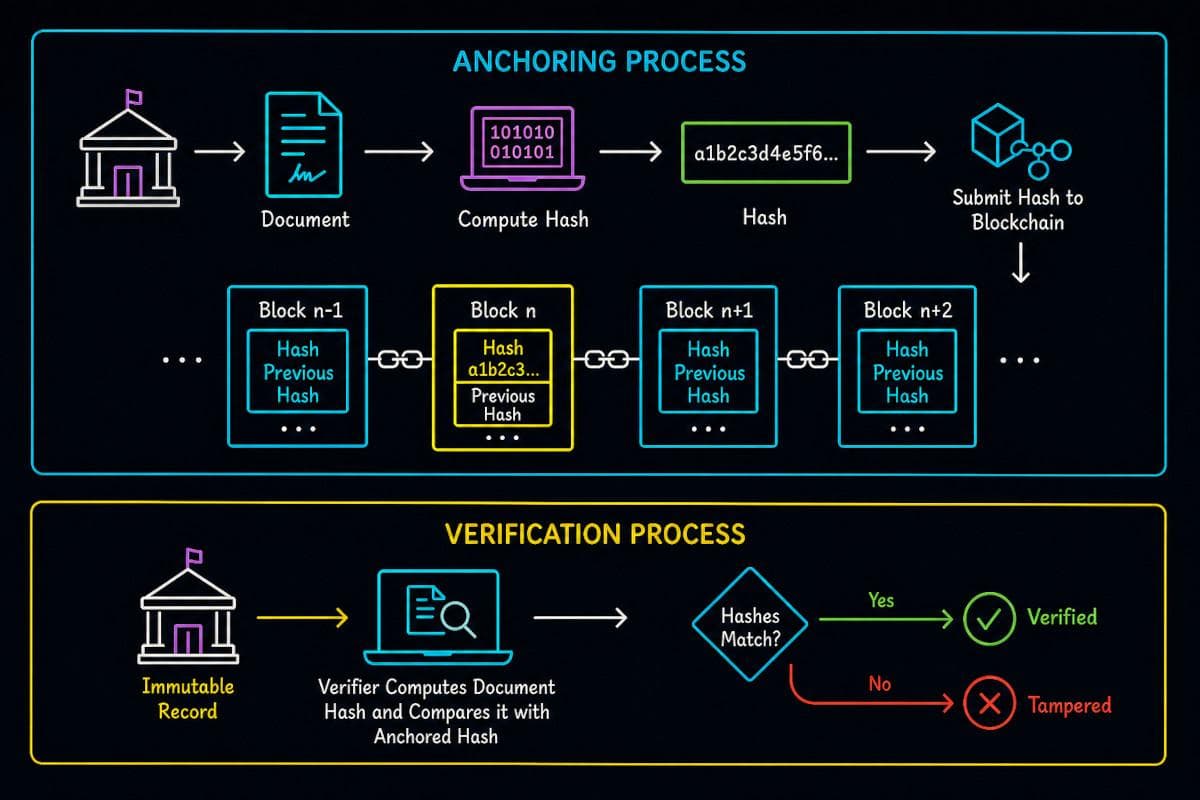
Government records sit at the center of public administration, legal accountability, and citizen trust. From permits and licenses to land records, procurement files, regulatory decisions, and internal approvals, these records often need to be preserved accurately, retrieved reliably, and defended when challenged. But traditional recordkeeping systems do not always make that easy. Government agencies may still depend on fragmented databases, paper archives, manual certification processes, and siloed workflows. Even where records are digitized, questions can still arise about whether a file was altered, when it existed in a particular form, and how its integrity can be independently verified. This is where blockchain anchoring can add real value. Blockchain anchoring helps create a tamper-evident reference point for a record’s integrity and timing without exposing the record itself on-chain. For government institutions responsible for high-value, high-scrutiny records, that can be a significant advantage.
Why government records need stronger integrity protection
Government records are often relied on for:
- legal rights and obligations;
- regulatory enforcement;
- public accountability;
- procurement oversight;
- land and property administration;
- tax and revenue administration;
- licensing and permits;
- court and tribunal processes;
- audit and anti-corruption review; and
- historical and archival preservation.
Because of this, even a small question about authenticity or alteration can have serious consequences.
Agencies may face challenges such as:
- disputed versions of records;
- unauthorized edits;
- weak audit trails;
- fragmented storage systems;
- delays in verification;
- poor inter-agency trust;
- document fraud; and
- difficulty proving when a record existed in a particular form.
Blockchain anchoring helps address these issues by adding an independent, tamper-evident layer of verification.
Key benefits of blockchain anchoring for government records
1. Stronger proof of record integrity
One of the main benefits of blockchain anchoring is that it helps agencies show whether a record has remained unchanged since a specific point in time.
If a permit, approval letter, land record, procurement document, or internal decision memo is later questioned, the anchored hash can help support verification that the file still matches the version that was previously recorded.
This is especially useful where records may later be reviewed in:
- audits;
- investigations;
- administrative appeals;
- procurement disputes;
- anti-corruption inquiries; or
- court proceedings.
2. Better proof of existence at a point in time
Government agencies often need to show that a record existed by a certain date, whether for compliance, legal, regulatory, or administrative reasons.
Blockchain anchoring helps create a timestamped reference that supports proof that a document existed in a particular form at or before the anchoring time.
This can be valuable for:
- policy approvals;
- regulatory notices;
- procurement submissions;
- tax filings;
- licensing records;
- land administration records; and
- internal authorizations.
3. Tamper-evident record preservation
Traditional digital storage may preserve access to a file, but it does not always provide strong independent proof that the file has not been altered.
Blockchain anchoring adds a tamper-evident layer. If a record is modified after anchoring, the new version will not produce the same hash as the anchored version.
That makes unauthorized changes easier to detect and helps agencies preserve confidence in the integrity of official records.
4. Improved audit and oversight readiness
Government records are frequently reviewed by:
- internal auditors;
- external auditors;
- anti-corruption bodies;
- legislative oversight committees;
- regulators;
- ombuds institutions; and
- courts or tribunals.
Blockchain anchoring can make it easier to demonstrate that key records were preserved in a verifiable way. This can improve audit readiness and reduce the burden of proving integrity through manual explanations alone.
5. Stronger public trust in digital government systems
As governments digitize more services, public trust becomes increasingly important.
Citizens, businesses, and oversight bodies need confidence that digital records are authentic, complete, and resistant to manipulation. Blockchain anchoring can help support that confidence by providing a more transparent and independently verifiable integrity mechanism.
This is particularly relevant for high-trust public functions such as:
- land registries;
- procurement systems;
- licensing platforms;
- public notices;
- tax administration; and
- regulatory filings.
6. Reduced dependence on a single internal system
In many agencies, trust in a record depends entirely on the internal database or archive where it is stored. If that system is challenged, migrated, compromised, or poorly documented, proving integrity can become difficult.
Blockchain anchoring provides an external reference point that is not dependent solely on one internal repository. That can be especially useful during:
- system migrations;
- archival transfers;
- inter-agency sharing;
- vendor transitions; or
- long-term preservation.
7. Better support for inter-agency verification
Government work often involves multiple institutions relying on the same or related records.
For example:
- a land authority, court, and tax agency may all rely on property records;
- a procurement authority and anti-corruption body may review the same contract file;
- a licensing authority and regulator may need to verify the same approval record.
Blockchain anchoring can help support more reliable verification across agencies by allowing records to be checked against a common integrity reference.
8. Stronger evidentiary support in disputes and investigations
Government records are often central to disputes, enforcement actions, and investigations.
Where a record’s authenticity or integrity is challenged, blockchain anchoring can help support evidentiary arguments by showing that the record matches a previously anchored version.
It does not automatically resolve every legal issue, but it can strengthen the technical and documentary basis for defending the integrity of official records.
9. Support for long-term digital preservation
Government records may need to be preserved for years or decades.
Over time, systems change, vendors change, storage environments change, and institutional memory can fade. Blockchain anchoring helps preserve a durable integrity reference that can remain useful even as the surrounding technology stack evolves.
This makes it a valuable complement to broader digital preservation and records management strategies.
10. Privacy-conscious verification
A major advantage of blockchain anchoring is that agencies do not need to publish the actual record on-chain.
Instead, they can keep sensitive records confidential while anchoring only the cryptographic hash. This allows agencies to strengthen verification without exposing personal data, classified content, or confidential administrative information on a public ledger.
That makes blockchain anchoring more practical for government use than models that depend on public disclosure of the underlying record.
Common government record types that can benefit
Blockchain anchoring can be useful for many categories of public records, including:
- land and property records;
- permits and licenses;
- procurement and contract records;
- regulatory filings;
- tax and revenue records;
- public notices and gazettes;
- court-related administrative records;
- policy approvals and internal authorizations;
- archival records; and
- compliance and inspection records.
The exact use case will depend on the agency’s legal, operational, and technical environment.
Best practices for government use
To use blockchain anchoring effectively, agencies should follow a few core principles.
Keep records off-chain
Sensitive government records should remain in secure internal systems or approved repositories. Only the hash should be anchored on-chain.
Integrate with records management workflows
Anchoring should support, not replace, proper records classification, retention, access control, and audit processes.
Preserve metadata and audit trails
The value of anchoring increases when agencies also maintain strong metadata, version history, and event logs.
Define governance and authority
Agencies should clearly define who can anchor records, when anchoring occurs, and how verification is handled.
Align with legal and regulatory requirements
Blockchain anchoring should be implemented in a way that fits public records laws, privacy obligations, procurement rules, and evidentiary requirements.
How Lexkeep supports government record integrity
Lexkeep helps institutions strengthen trust in important records through blockchain-backed document verification.
With Lexkeep, government agencies and public-sector teams can:
- generate cryptographic hashes for key records;
- anchor record hashes on the blockchain;
- preserve records securely off-chain;
- maintain tamper-evident proof of integrity and timing;
- support audit and verification workflows; and
- generate File Integrity Certificates for records that may later need to be reviewed or relied on.
This helps agencies improve record defensibility without exposing sensitive government documents on-chain.
Conclusion
Government records are not just administrative files. They are instruments of authority, accountability, and public trust.
Blockchain anchoring offers a practical way to strengthen the integrity, verifiability, and defensibility of those records. For agencies managing high-value public documents, it can serve as an important complement to secure storage, audit trails, and sound records management practices.