
Modern Software for Securing and Tracking Legal Agreements
Published on: (Updated on: )
Legal agreements are among the most important records any legal or compliance team manages. From contracts and settlement agreements to NDAs, board resolutions, employment terms, and vendor documentation, these records need to be stored securely, tracked properly, and retrieved quickly when needed.
Yet many organizations still manage legal agreements through a mix of email attachments, shared folders, local drives, and manual follow-up. This often creates avoidable risks around version control, access, proof of execution, and document history.
Modern software for securing and tracking legal agreements helps legal teams move beyond fragmented document handling. It gives them a more reliable way to organize agreements, control access, monitor changes, and maintain a defensible record of important legal documents.
For legal and compliance teams, this is no longer just a matter of convenience. It is a matter of control, security, and operational efficiency.
Why legal agreement management is often harder than it should be
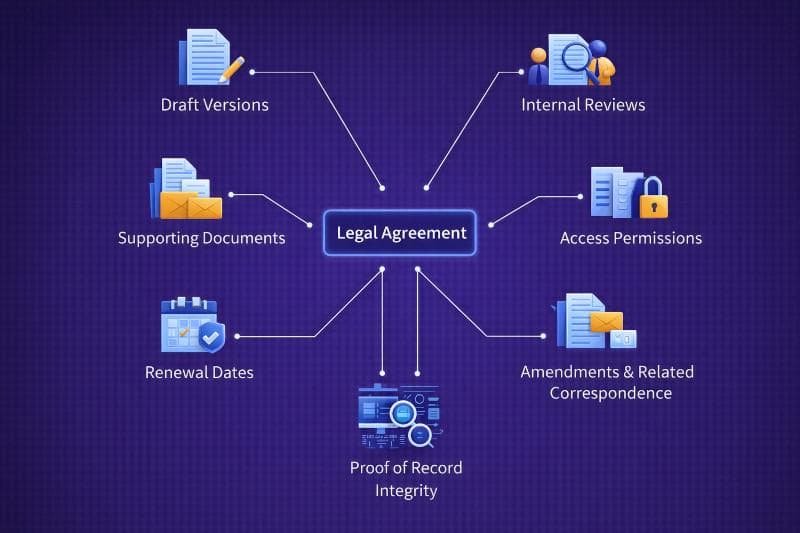
Legal agreements may look straightforward once signed, but the process around them is rarely simple. Teams often need to manage:
- draft versions
- internal reviews
- approvals
- final execution copies
- supporting documents
- access permissions
- renewal dates
- amendments
- related correspondence
- proof of record integrity
When these records are spread across different systems, it becomes harder to know which version is final, who has access, what changed, and where the latest copy is stored.
This can create delays, confusion, and unnecessary legal risk.
Common problems with manual agreement tracking
Many legal teams still rely on manual methods to track agreements. These may include spreadsheets, email chains, shared drives, or physical files. While familiar, these methods often break down as document volume grows.
Common issues include:
Poor version control
Multiple drafts may circulate without a clear record of which version was approved or signed.
Weak access control
Sensitive agreements may be shared too broadly or stored in locations with inconsistent permissions.
Missing deadlines
Renewal dates, review dates, and follow-up obligations may be overlooked without reminders or structured tracking.
Scattered records
Agreements, attachments, and related communications may be stored in different places, making retrieval slower and less reliable.
Limited audit trail
It may be difficult to show when a document was uploaded, updated, shared, or finalized.
These problems become more serious when agreements are commercially sensitive, highly regulated, or likely to be reviewed later.
What modern legal agreement software should do
Modern software for legal agreement management should do more than store files. It should help legal and compliance teams secure agreements, track their lifecycle, and maintain confidence in the integrity of the record.
A strong system should support:
- secure document storage
- agreement tracking across matters or teams
- version control
- access management
- searchable records
- document history
- secure file sharing
- reminders for key dates
- audit trails
- reliable record keeping
This gives legal teams a more structured way to manage agreements from draft to execution and beyond.
Why security matters for legal agreements
Legal agreements often contain confidential, commercially sensitive, or regulated information. That makes security a core requirement, not an optional feature.
A secure agreement management system helps legal teams protect:
- confidential terms
- client information
- internal approvals
- negotiation history
- executed copies
- related legal records
Strong security controls also help reduce the risk of unauthorized access, accidental sharing, or document loss.
For legal and compliance teams, secure storage and controlled access are essential to maintaining trust and reducing exposure.
Why tracking matters just as much as storage
Storing an agreement is only one part of the job. Legal teams also need to track what happens around the agreement over time.
This may include:
- who reviewed it
- who approved it
- when it was finalized
- where the signed version is stored
- whether it has been amended
- when it should be reviewed again
- what obligations or deadlines are attached to it
Without structured tracking, agreements can become difficult to manage after execution. Important dates may be missed, outdated versions may be used, and teams may lose visibility into the status of key legal records.
How Lexkeep helps secure and track legal agreements
Lexkeep helps legal and compliance teams manage legal agreements in a more secure, organized, and reliable way. Instead of relying on disconnected folders and manual tracking, teams can manage agreements within a structured digital system.
This helps centralize records, improve visibility, and maintain stronger control over important legal documents.
Document management for legal agreements
Lexkeep’s document management capabilities help teams store, organize, and retrieve legal agreements more efficiently. Drafts, final versions, amendments, and supporting files can be kept in one place, making it easier to maintain a complete agreement record.
This improves version control and reduces the time spent searching for the right document.
Matter-based organization for better context
Legal agreements often relate to a broader matter, transaction, client, dispute, or compliance issue. Lexkeep’s matter management helps teams organize agreements within the right legal context.
This means agreements are not stored as isolated files. They are linked to the relevant matter, making it easier to understand their purpose, history, and related records.
Secure legal file sharing
Legal teams often need to share agreements with internal stakeholders, external counsel, clients, counterparties, or compliance teams. Lexkeep supports secure legal file sharing so these documents can be shared more safely and with better control.
This reduces reliance on fragmented email attachments and helps maintain a more secure collaboration process.
Electronic signing for agreement execution
Lexkeep also supports electronic signing, helping legal and compliance teams send agreements for signature, track execution, and keep signed copies connected to the relevant matter or document record.
This helps teams manage agreement execution in a more structured workflow, while maintaining better visibility into signing status, final copies, and document history.
Blockchain record keeping for stronger document integrity
For important legal agreements, record integrity matters. Lexkeep’s blockchain record keeping helps strengthen confidence in the timing and integrity of key legal records.
This can support a more reliable record of:
- document history
- timestamps
- stored agreement records
- key updates and actions
Where questions later arise about when a document was stored, updated, or preserved, blockchain-backed record keeping can help support a more defensible audit trail.
Audit trails and visibility across the agreement lifecycle
Lexkeep helps legal teams maintain better visibility into the lifecycle of legal agreements. This includes document history, updates, storage, and related activity across the matter.
A clearer audit trail helps teams show how an agreement was handled and maintain better internal control over important records.
Use cases for legal agreement tracking software
Modern software for securing and tracking legal agreements can support a wide range of legal and compliance workflows, including:
- commercial contracts
- non-disclosure agreements
- employment agreements
- settlement agreements
- board and governance records
- vendor and procurement agreements
- compliance documentation
- client engagement records
In each of these cases, secure storage and reliable tracking help reduce risk and improve operational efficiency.
Why modern legal teams need a better system
As legal work becomes more digital and collaborative, manual agreement tracking becomes harder to maintain. Teams need a better way to secure documents, control access, track updates, and retrieve records quickly.
Modern software helps legal and compliance teams move from fragmented document handling to a more structured and defensible workflow. That improves both day-to-day efficiency and long-term record management.
Conclusion
Legal agreements should not be left to scattered folders, manual reminders, or inconsistent version control. They are too important, too sensitive, and too central to legal operations.
Modern software for securing and tracking legal agreements helps legal and compliance teams maintain stronger control over document security, agreement history, and record integrity.
Lexkeep supports this through document management, matter management, secure legal file sharing, and blockchain record keeping. For teams handling sensitive legal records, that means a more secure, organized, and reliable way to manage agreements from start to finish.