
How Blockchain Immutability Supports Legal Cases
Published on: (Updated on: )
As legal work becomes more digital, disputes increasingly turn on the integrity of electronic records. Contracts, emails, approvals, filings, internal reports, and digital evidence can all become central to a case. But when records are stored in ordinary systems, questions often arise later: Was the document altered? When did it exist? Can the timeline be trusted? Is there an independent way to verify it?
This is where blockchain immutability becomes relevant. By helping preserve tamper-evident, time-stamped, and independently verifiable records, blockchain can support legal cases where authenticity, integrity, and timing matter.
For law firms, in-house legal teams, compliance teams, investigators, and organizations handling sensitive records, understanding how blockchain immutability supports legal cases is becoming increasingly important.
What is blockchain immutability?
Blockchain immutability refers to the difficulty of altering data once it has been recorded on a blockchain. In simple terms, once a record is anchored on a blockchain and confirmed, changing it later without detection becomes extremely difficult.
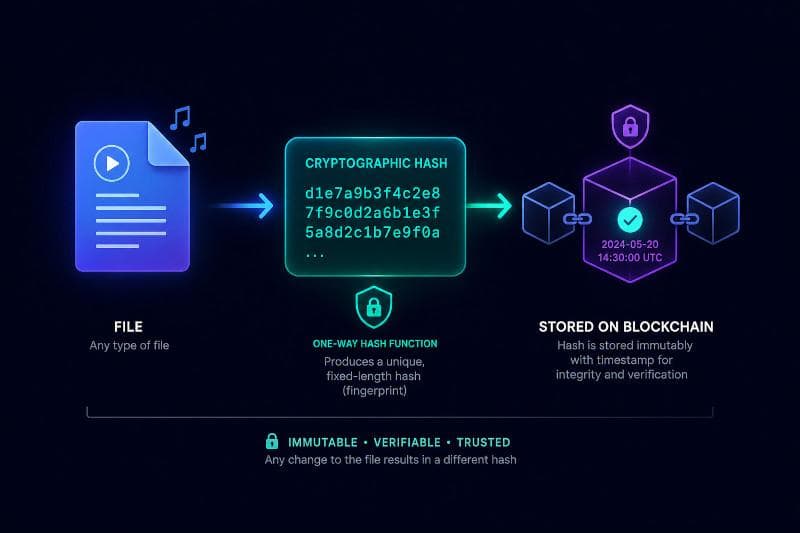
This does not mean every legal document should be stored directly on-chain. In many practical legal and business workflows, the better approach is to store the original file securely off-chain and anchor a cryptographic hash of that file on a blockchain.
A cryptographic hash acts like a unique digital fingerprint. If the file changes, the hash changes. This makes blockchain useful for proving that a document existed in a specific form at a specific time.
Why blockchain immutability matters in legal cases
Legal disputes often involve questions about:
- document authenticity
- record integrity
- timing of events
- chain of custody
- audit trails
- unauthorized changes
- missing or disputed records
Traditional digital storage can preserve files, but it may not always provide strong independent proof of integrity. Files can be overwritten, renamed, deleted, or challenged. Internal logs may also be questioned if they depend entirely on one system or one administrator.
Blockchain immutability helps address this by adding a tamper-evident and independently verifiable layer of proof. That can make a meaningful difference in legal cases where the reliability of digital records is under scrutiny.
How blockchain immutability supports legal cases
1. It helps prove document integrity
One of the most important ways blockchain immutability supports legal cases is by helping prove that a document has not changed since a certain point in time.
When a document hash is anchored on a blockchain, legal teams can later compare the current file against the original hash. If the hashes match, it supports the argument that the document remains unchanged.
This can be useful for:
- contracts
- witness statements
- affidavits
- board resolutions
- compliance records
- internal approvals
- legal correspondence
- intellectual property records
In disputes over altered documents, this kind of verification can be highly valuable.
2. It supports reliable timestamping
Timing is often central to legal disputes. Parties may disagree about when a document was created, when notice was given, when approval occurred, or when a record first existed.
Blockchain anchoring can provide a publicly verifiable time stamp tied to a document hash. This can help support legal arguments involving:
- contract formation
- regulatory filings
- employment disputes
- insurance claims
- intellectual property claims
- commercial transactions
- internal investigations
Where timing matters, blockchain immutability can help strengthen the evidentiary timeline.
3. It strengthens audit trails
Legal and compliance matters often depend on a clear history of actions. Blockchain-backed verification can complement internal audit trails by adding an external layer of proof.
This can support matters involving:
- corporate governance
- compliance reviews
- financial controls
- internal approvals
- policy acknowledgements
- document handling history
- dispute resolution
A stronger audit trail can make it easier to reconstruct events and defend the integrity of records.
4. It supports chain of custody for digital evidence
In legal cases involving digital evidence, chain of custody is critical. Lawyers, investigators, and compliance teams may need to show how evidence was collected, preserved, and handled over time.
Blockchain immutability can support this by helping preserve tamper-evident proof linked to evidence files and related records. This can be useful in:
- internal investigations
- forensic workflows
- e-discovery processes
- regulatory enforcement matters
- fraud reviews
- workplace investigations
When evidence handling is challenged, stronger integrity verification can support credibility.
5. It reduces the risk of silent record manipulation
A major concern in legal disputes is whether records were altered after the fact. Blockchain immutability helps reduce this risk by making changes detectable.
This is especially relevant where one party alleges:
- backdating
- unauthorized edits
- document substitution
- deletion of records
- manipulation of internal logs
Tamper-evident verification does not automatically prove who made a change or why, but it can help show whether a record remained consistent over time.
Common legal use cases for blockchain immutability
Blockchain immutability can support legal cases across many different contexts.
Contract disputes
Blockchain-backed timestamps and document hashes can help support claims about when an agreement existed, whether it changed, and which version is being relied upon.
Intellectual property protection
Creators and businesses can anchor drafts, designs, code, and creative works to help establish existence at a particular time.
Compliance and regulatory matters
Organizations can maintain stronger records of approvals, disclosures, acknowledgements, and reporting activity.
Employment and workplace investigations
Immutable verification can support records of policy distribution, acknowledgements, access events, and internal reporting timelines.
Public records and official documents
Blockchain-backed verification can support stronger integrity for land records, certificates, official filings, and other high-value records.
Financial and tax records
Organizations can maintain more auditable and transparent records where timing, integrity, and traceability matter.
Document authentication
Blockchain can be used to store hashes for fast authenticity checks without exposing sensitive file contents on-chain.
Does blockchain immutability make evidence automatically admissible?
No. Blockchain immutability can strengthen the credibility and integrity of digital records, but it does not automatically make evidence admissible in court.
Courts and tribunals still apply rules relating to:
- relevance
- authenticity
- admissibility
- procedural compliance
- chain of custody
- evidentiary weight
What blockchain immutability can do is help support authenticity and integrity arguments. It can reduce uncertainty around whether a record existed at a certain time and whether it has been altered since.
Jurisdictional developments supporting blockchain evidence and timestamping
Blockchain-backed records and timestamps are increasingly being recognized in legal and regulatory contexts across multiple jurisdictions. While treatment varies by country and by case, several developments show growing institutional acceptance of blockchain-supported evidence and record integrity workflows.
- European Union: Under eIDAS Article 41, an electronic time stamp cannot be denied legal effect and admissibility as evidence in legal proceedings solely because it is in electronic form or because it does not meet the requirements of a qualified electronic time stamp.
- France: In 2025, the Court of Marseille recognised blockchain timestamping as legitimate evidence of copyright ownership. This reflects the growing judicial openness to blockchain-based evidentiary support in appropriate cases.
- Italy: Law No. 12/19, dated 11 January 2019 and effective from 13 February 2019, strengthened the legal recognition of blockchain-based timestamping. Article 8 ter, paragraph 3 provides that the storage of a computerized document through distributed ledger technologies has the same legal effect as an electronic time stamp under Regulation (EU) No. 910/2014 (eIDAS).
- Delaware, United States: In 2017, Delaware amended Title 8 of the Delaware Code relating to the General Corporation Law to provide specific statutory authority for Delaware corporations to use distributed ledgers or blockchain for the creation and maintenance of corporate records, including the corporation’s stock ledger.
- China: In 2018, China’s Supreme People’s Court ruled that internet courts could recognize blockchain data as a form of digital evidence, subject to applicable evidentiary requirements.
These developments do not eliminate the need to satisfy local evidentiary rules, authenticity requirements, or procedural standards. But they do show that blockchain-backed timestamps, records, and verification methods are increasingly relevant in real legal systems.
Best practices for using blockchain in legal and compliance workflows
To make blockchain immutability genuinely useful in legal cases, organizations should follow practical best practices.
Store documents off-chain
Sensitive legal and business documents should usually remain in secure off-chain storage. Only verification data, such as hashes, should be anchored on a blockchain.
Preserve the original file carefully
Blockchain verification is only useful if the original file is preserved properly and can later be compared against the anchored hash.
Maintain audit trails
Internal audit logs still matter. Blockchain works best when combined with strong document management, access controls, and audit records.
Use clear verification workflows
Legal teams should be able to explain how a document was hashed, anchored, stored, and later verified.
Protect confidentiality
Public blockchains should not be used to expose confidential legal content. Verification should support integrity without compromising privacy.
Align with legal and evidentiary requirements
Technology should support legal strategy, not replace it. Workflows should be designed with evidentiary, regulatory, and privacy requirements in mind.
Why blockchain immutability is becoming more important for legal teams
As legal operations become more digital, disputes over electronic records are becoming more common. Law firms, legal departments, compliance teams, and public institutions increasingly need stronger ways to prove:
- that a document existed
- that it has not been altered
- that a timeline can be trusted
- that records can be verified independently
Blockchain immutability helps meet this need by adding a stronger integrity layer to digital records. It does not replace legal analysis, but it can strengthen the evidentiary foundation behind important documents and records.
How Lexkeep helps organizations protect document integrity
Lexkeep helps organizations protect document integrity with blockchain-based document verification software designed for secure, practical workflows.
With Lexkeep, organizations can:
- store documents securely off-chain
- anchor verification data on blockchain
- maintain tamper-evident, publicly verifiable records
- support audit trails and document verification
- generate stronger proof of document integrity without exposing sensitive files publicly
If your team handles contracts, compliance records, official documents, investigation files, or other high-value records, Lexkeep can help you build stronger trust in your digital evidence and document workflows.
Conclusion
Blockchain immutability supports legal cases by helping preserve stronger proof of document integrity, timing, and authenticity. In disputes involving digital records, that can make a meaningful difference.
For legal and compliance teams, the real value lies not in blockchain hype, but in practical verification: proving that a record existed, showing that it has not changed, and supporting a more defensible evidentiary trail.
As digital records continue to shape legal disputes, blockchain-backed verification is likely to become an increasingly important part of legal risk management and record integrity strategy.