
Blockchain-Backed Financial Record Keeping
Blockchain Financial Records for Tamper-Proof Financial Record Keeping
Financial records sit at the center of trust, accountability, and compliance. Whether the issue is an audit, internal review, investor diligence, regulatory inquiry, or dispute, organizations need to be able to show that their records are accurate, preserved, and unchanged. That is why more businesses are exploring blockchain financial records and tamper-proof financial record keeping as a better way to strengthen trust in financial documentation.
At Lexkeep, we help organizations preserve financial records with blockchain-backed integrity verification. Instead of putting sensitive accounting or finance data on-chain, Lexkeep anchors a cryptographic proof of the record to blockchain, creating an independent and verifiable integrity layer.
The result is a practical model for tamper-proof financial record keeping that supports audit readiness, evidence preservation, and trusted financial governance.
What Are Blockchain Financial Records?
Blockchain financial records are financial documents, reports, or record sets whose integrity is supported by blockchain-based proof.
This does not mean the actual invoice, ledger export, reconciliation file, or board pack is stored on a public blockchain. In most enterprise use cases, the better design is to keep the original record off-chain while anchoring a cryptographic hash of that record on-chain.
That anchored hash acts as a digital fingerprint. If the file changes later, the fingerprint changes too. By comparing the current file hash against the blockchain-anchored hash, organizations can verify whether the record remains unchanged.
This is what makes blockchain useful for financial records: not as a replacement for storage, but as a tool for proof of integrity and proof of existence.
What Is Tamper-Proof Financial Record Keeping?
Tamper-proof financial record keeping refers to a record management approach that makes unauthorized changes detectable and supports verifiable proof that a record has not been altered since a known point in time.
For finance teams, this is important because many critical records need to remain defensible long after they are created.
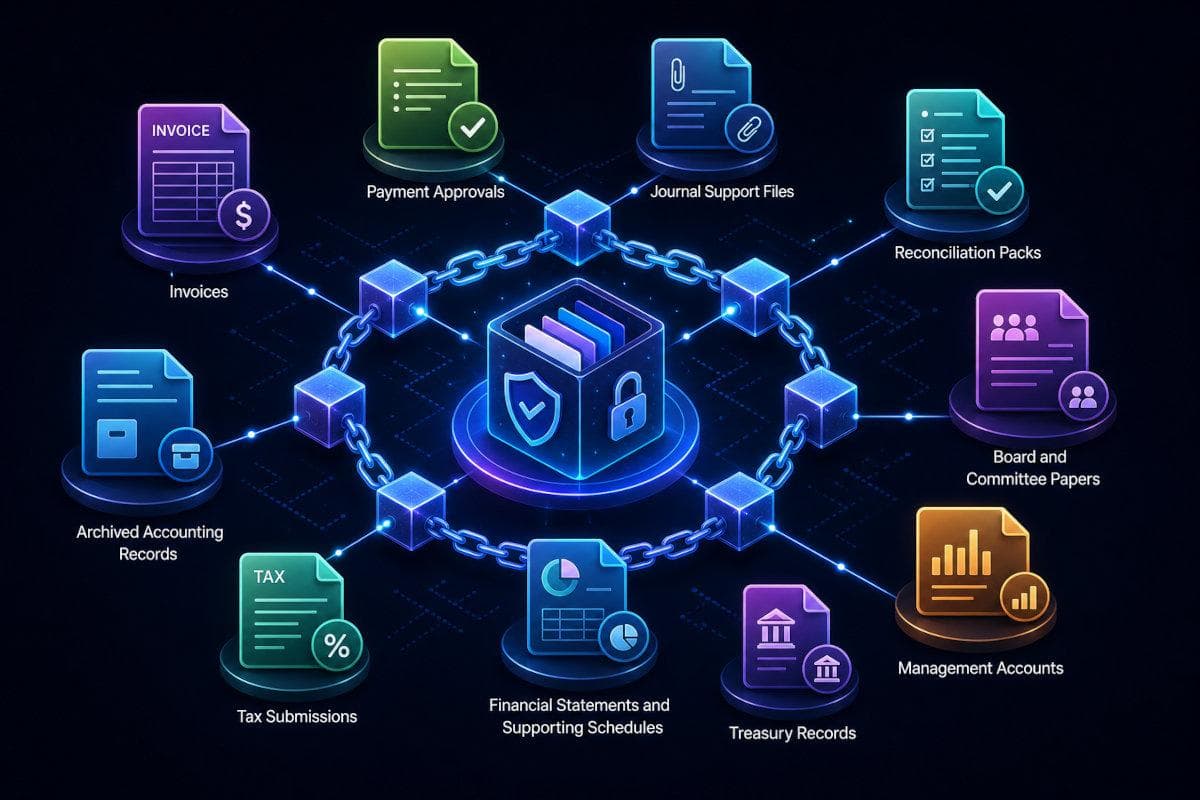
Examples include:
- invoices
- payment approvals
- journal support files
- reconciliation packs
- board and committee papers
- management accounts
- treasury records
- financial statements and supporting schedules
- tax submissions
- archived accounting records
A tamper-proof approach helps answer important questions:
- Is this the same file that was approved or submitted?
- Has this record been altered after finalization?
- Can we independently verify its integrity?
- Can we show when the record existed in this exact form?
How Blockchain-Backed Financial Record Keeping Works
Lexkeep uses blockchain anchoring to strengthen the integrity of financial records without exposing confidential content.
A typical workflow looks like this:
- A financial record is uploaded, finalized or approved.
- Lexkeep generates a cryptographic hash of the file or canonical record representation.
- That hash, or a batch commitment based on multiple hashes, is anchored to blockchain.
- Lexkeep stores the related verification metadata.
- Later, the record can be rehashed and compared to the anchored proof.
If the recalculated hash matches the blockchain-anchored value, the integrity of the record can be verified.
This makes blockchain-backed financial record keeping especially valuable for organizations that need trustworthy and independently verifiable archives.
Why Businesses Need Blockchain for Financial Records
Search interest in blockchain for financial records is growing because organizations are under increasing pressure to improve transparency, governance, and control evidence.
Finance and compliance teams need more than basic file storage. They need systems that help prove:
- when a financial record was created or finalized
- whether it has remained unchanged
- whether internal records can be independently verified
- whether evidence can be produced quickly for audits, reviews, or disputes
Traditional storage systems may show where a file lives. Blockchain-backed integrity controls help show whether the file is still the same.
That distinction is important.
Benefits of Tamper-Proof Financial Record Keeping
Stronger Audit Readiness
Auditors often need assurance that records are complete, preserved, and unchanged. Blockchain-backed integrity verification helps support that process with clear proof artifacts.
Better Financial Record Integrity
A blockchain-anchored hash makes later modification detectable, improving confidence in the integrity of finalized records.
Independent Verification
Instead of relying only on internal systems and database logs, organizations can point to a blockchain transaction as an independent reference point.
Improved Dispute Defensibility
If a record is challenged, it is easier to demonstrate that a specific version existed at a specific time and has not been altered since.
Stronger Governance and Oversight
Finance leaders, boards, and compliance teams benefit from more reliable record preservation and clearer evidentiary support.
Privacy-Conscious Design
Sensitive financial files stay off-chain, while only the proof of integrity is anchored on-chain.
Blockchain Financial Records Without Putting Sensitive Data On-Chain
One common misconception is that blockchain-based record keeping requires organizations to publish actual financial data to a public blockchain.
That is not necessary, and for most businesses it would be undesirable.
Lexkeep’s approach is built around a more practical model:
- the underlying financial record remains off-chain
- access stays controlled within the platform
- only a hash or commitment is anchored to blockchain
- verification remains possible without exposing confidential content
This makes the solution suitable for:
- private companies
- regulated organizations
- law firms and legal departments
- finance teams handling sensitive records
- businesses with confidentiality and data protection obligations
Use Cases for Blockchain Financial Records
Organizations can use Lexkeep for many forms of blockchain-backed financial record keeping, including:
Invoice and Payment Record Integrity
Preserve trusted evidence around invoices, payment approvals, and transaction support documents.
Financial Statement Support
Anchor proofs for statements, schedules, and supporting materials used in reporting processes.
Accounting Archive Preservation
Create tamper-evident archives for accounting records that need long-term retention.
Board and Governance Materials
Support trust in financial board packs, resolutions, and committee documents.
Tax and Compliance Documentation
Preserve the integrity of filed or finalized tax and regulatory records.
Treasury and Funding Records
Strengthen confidence in records tied to financing, cash management, and capital activity.
File Integrity Evidence for Financial Records
For blockchain-backed verification to be useful, it has to be understandable by finance, audit, legal, and compliance stakeholders.
That is why Lexkeep supports a File Integrity Evidence Report for verification, audit, compliance, and evidentiary support purposes.
A typical report may include:
- file or record reference
- integrity status
- cryptographic hash
- hashing method
- anchor date and time
- blockchain transaction reference
- verification link
- blockchain explorer link
This turns technical blockchain evidence into a usable proof artifact for business review and external assurance processes.
Why Lexkeep for Tamper-Proof Financial Record Keeping?
Lexkeep helps organizations move from ordinary storage to verifiable financial record keeping.
With blockchain-backed proof, controlled off-chain storage, and verification-ready evidence, Lexkeep supports a more trusted approach to preserving critical financial records.
This is especially valuable for organizations that want to improve:
- financial record integrity
- audit support
- evidentiary readiness
- internal controls
- confidence in long-term archives
Blockchain Financial Records for the Future of Trust
As financial governance expectations continue to rise, organizations need better ways to preserve trust in their records.
Blockchain financial records offer a practical path forward by adding independent, tamper-evident proof to the record-keeping process. And with tamper-proof financial record keeping, organizations are better positioned to support audits, investigations, compliance reviews, and business-critical decisions.
Lexkeep helps make that possible — by keeping the record off-chain, anchoring the proof on-chain, and making verification simple.
Strengthen Financial Record Integrity with Lexkeep
If your organization is looking for a better way to preserve trusted financial documentation, Lexkeep provides a modern approach to:
- blockchain financial records
- tamper-proof financial record keeping
- proof of data integrity
- verifiable financial archives
- audit-ready record preservation
Preserve financial records with confidence. Verify them with evidence. Prove their integrity when it matters most.