

Record Keeping Requirements for Businesses: What You Need to Know
Published on:
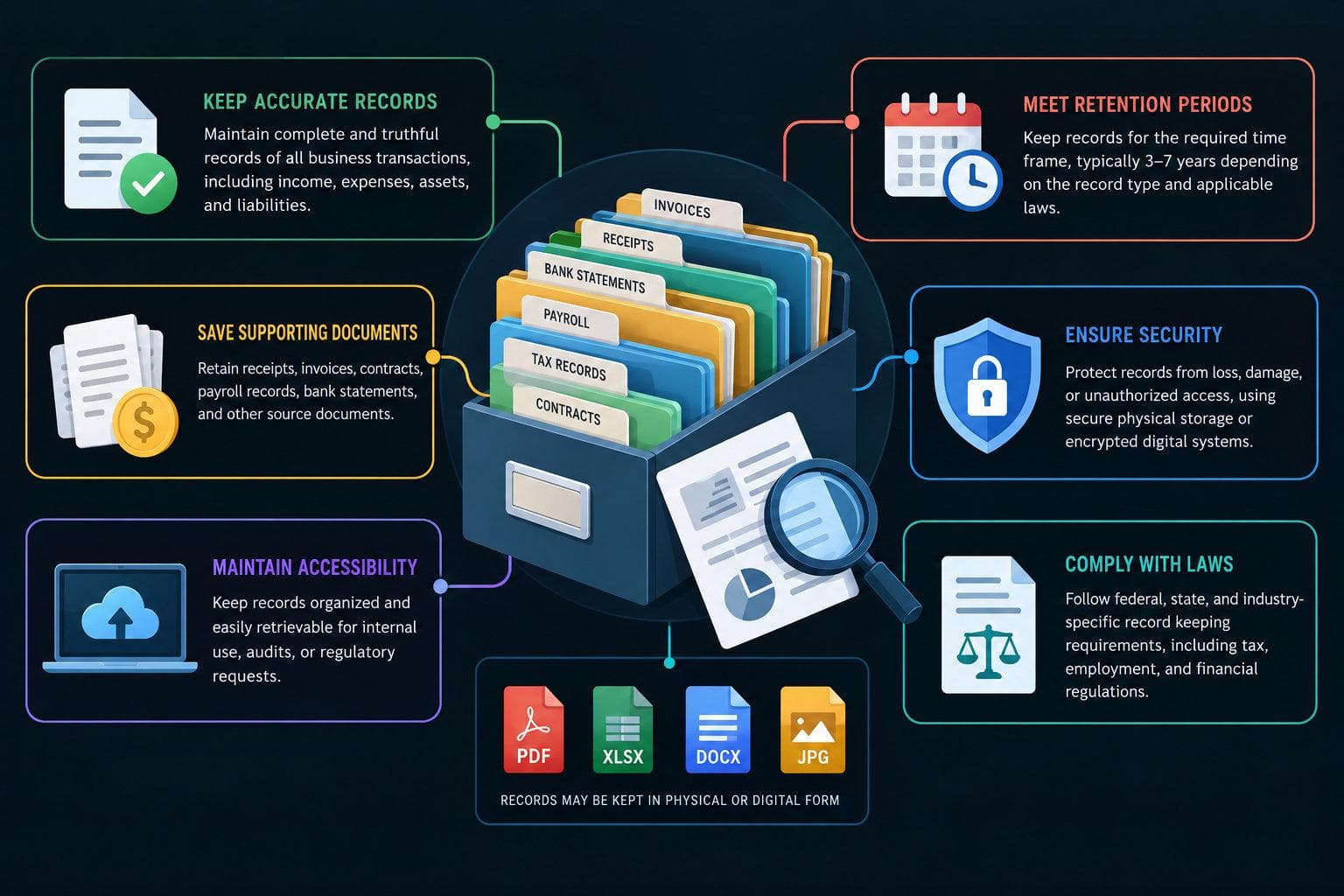
Record-Keeping Requirements for Businesses
Businesses create records every day: contracts, invoices, receipts, approvals, board resolutions, meeting minutes, employee documents, policies, correspondence, reports, and other operational information.
But keeping records is not only an administrative task. Depending on the type of record, the organisation, the industry, and the applicable jurisdiction, the law may require certain records to be created, retained, protected, and made available when needed.
Why do businesses need to keep records?
Business records help demonstrate what happened, when it happened, and who was involved.
Good records can help an organisation:
- Demonstrate compliance with legal and regulatory obligations
- Support tax, accounting, and financial reporting
- Confirm contractual rights and obligations
- Preserve evidence of approvals and business decisions
- Respond to audits, investigations, or regulatory requests
- Resolve disputes
- Protect the organisation from unsupported claims
- Support continuity when employees or advisers change
- Retrieve important information efficiently
Records may be needed long after the original transaction, decision, or communication has taken place.
Is there one legal retention period for all records?
No. There is usually no single retention period that applies to every business record.
The appropriate retention period may depend on:
- The type of record
- The organisation’s activities
- The industry in which it operates
- The applicable jurisdiction
- Tax and accounting requirements
- Employment and workplace obligations
- Corporate and governance requirements
- Contractual obligations
- Regulatory requirements
- Pending or anticipated disputes
- Data-protection and privacy obligations
- The organisation’s own approved retention policy
For this reason, businesses should not apply one blanket retention period to every document. Different categories of records may require different retention rules.
What types of records may need to be retained?
Corporate and governance records
These may include:
- Board resolutions
- Shareholder or member resolutions
- Meeting minutes
- Registers
- Corporate approvals
- Governance correspondence
- Constitutional and organisational documents
- Records of significant business decisions
These records may help demonstrate how the organisation was authorised to act and how important decisions were made.
Accounting and financial records
These may include:
- Invoices
- Receipts
- Payment records
- Expense records
- Purchase documents
- Financial statements
- Bank records
- Payroll-related records
- Supporting records for financial transactions
Financial records may be required to support accounting, tax, audit, reporting, or regulatory processes.
Contracts and commercial records
These may include:
- Customer contracts
- Supplier agreements
- Leases
- Service agreements
- Statements of work
- Purchase orders
- Amendments
- Renewals
- Notices
- Related correspondence
Businesses may need to retain these records for as long as the agreement is active and for an appropriate period afterwards, particularly where rights, obligations, warranties, claims, or disputes may continue.
Employment records
These may include:
- Employment agreements
- Personnel records
- Policies and acknowledgements
- Leave and attendance records
- Performance records
- Disciplinary records
- Payroll-related documents
- Workplace incident records
- Termination records
Employment records may be subject to specific legal, regulatory, privacy, and workplace requirements.
Tax and compliance records
These may include:
- Tax filings
- Tax calculations
- Supporting invoices and receipts
- Regulatory submissions
- Licences and permits
- Compliance reports
- Audit correspondence
- Risk assessments
- Internal compliance reviews
The required retention period may depend on the relevant tax or regulatory obligation.
Operational records
These may include:
- Policies and procedures
- Reports
- Project documents
- Meeting records
- Client communications
- Supplier communications
- Internal instructions
- Approvals
- Technical specifications
- Business continuity records
Operational records help preserve organisational knowledge and support consistency, accountability, and continuity.
What does the law expect from retained records?
Legal requirements may differ, but a proper record keeping system should generally help an organisation ensure that records are:
Accurate
The record should reflect the relevant transaction, communication, decision, or event accurately.
Reliable
The organisation should be able to explain how the record was created, received, approved, or maintained.
Complete
Important supporting information should not be separated from the main record without a clear reason.
Accessible
Authorised people should be able to retrieve the record when it is needed.
Protected
Records should be protected against unauthorised access, accidental loss, inappropriate alteration, and destruction.
Traceable
The organisation should be able to identify relevant activity, such as uploads, changes, approvals, sharing, or signing events.
Understandable
A record should retain enough context to show what it relates to, who was involved, and why it matters.
Retained for an appropriate period
Records should be kept for as long as required by law, contract, business need, dispute risk, or an approved retention policy.
Does a record have to be kept in paper form?
Not necessarily. Many organisations create, receive, store, and manage records electronically.
However, an electronic record should remain accessible and capable of being used for future reference. The organisation should also consider whether it can demonstrate:
- When the record was created or received
- Whether it has been changed
- Who had access to it
- Whether approvals were given
- Whether signatures were requested or completed
- What supporting documents relate to it
- How the record was stored and protected
The legal acceptability of an electronic record may depend on the applicable law, the type of record, and the circumstances in which it is being used.
What is a legal hold?
A legal hold is a direction to preserve relevant records because litigation, an investigation, an audit, or another formal process is pending or reasonably anticipated.
When a legal hold applies, an organisation may need to suspend ordinary deletion or destruction processes for relevant records. This can include records that would otherwise be deleted under a routine retention schedule.
Relevant records may include:
- Contracts
- Emails and correspondence
- Meeting records
- Board resolutions
- Policies
- Reports
- Invoices and receipts
- Internal messages
- Project documents
- Supporting files
A retention policy should not be used to destroy records that must be preserved for a legal or regulatory matter.
What happens if records are not properly maintained?
Poor record keeping can create practical and legal risks, including:
- Difficulty responding to audits or investigations
- Missed deadlines
- Inability to prove an approval or agreement
- Disputes about the correct version of a document
- Loss of important business knowledge
- Unauthorised disclosure of sensitive information
- Accidental destruction of relevant evidence
- Delays in responding to customers, suppliers, regulators, or advisers
- Reduced confidence in the organisation’s records
A missing, incomplete, or unreliable record may make it more difficult for an organisation to establish what happened.
How should a business create a records retention policy?
A records retention policy should be based on the organisation’s activities and legal obligations. It should identify:
- The categories of records the organisation creates or receives
- The person or team responsible for each category
- The applicable retention period or trigger
- Where records should be stored
- Who may access or manage them
- How records should be protected
- How legal holds will be implemented
- When records may be securely deleted or destroyed
- How exceptions and extensions will be approved
- How the policy will be reviewed and updated
Retention periods should be determined with appropriate input from legal, tax, accounting, compliance, records-management, and information-security professionals where necessary.
How Lexkeep supports business record keeping
Lexkeep helps businesses organise and manage important records in a controlled workspace.
Depending on the applicable plan, Lexkeep may support:
- Structured record organisation
- Secure document storage
- Controlled access
- Version management
- Event logs and audit trails
- Record retrieval
- Secure sharing
- E-signature requests
- Signing workflow tracking
- Retention workflows
- Legal holds
- File integrity verification
- Hash anchoring and File Integrity Certificates
Lexkeep can help an organisation maintain a clearer history of its records and related activity. It does not determine the retention period that applies to a particular record and does not replace legal, tax, accounting, compliance, or records-management professionals.
Conclusion
The legal requirement for keeping records depends on the type of record, the organisation, the industry, the applicable jurisdiction, and the circumstances in which the record may be needed.
Businesses should maintain records that are accurate, reliable, secure, accessible, and retrievable. They should also establish appropriate retention policies, preserve records subject to legal holds, and avoid deleting information that must be retained for legal, regulatory, contractual, or operational reasons.
A structured records-management system can help an organisation protect important information and demonstrate what happened when it matters.
This article provides general information only. It is not legal, tax, accounting, compliance, or records-management advice. Organisations should obtain advice on the specific retention obligations that apply to their activities and jurisdiction.