
Secure Cloud-Based Document Management Software
Published on:
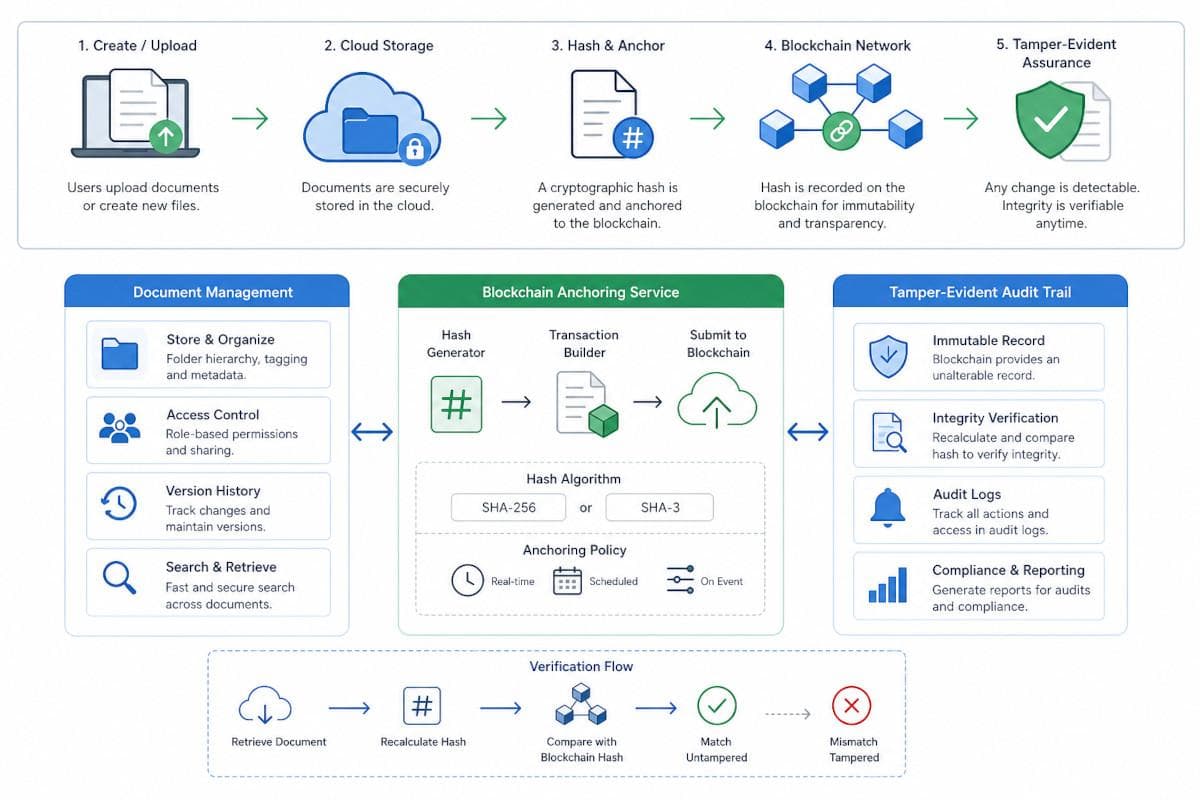
Modern organizations need more than simple file storage. They need a reliable way to manage documents, track every important action, and demonstrate that records have not been altered. A cloud-based document management system with integrated blockchain anchoring and a strong tamper-evident audit trail helps meet those needs by combining accessibility, accountability, and record integrity.
Why cloud-based document management matters
Cloud-based document management gives teams a centralized environment for storing, organizing, accessing, and managing records from anywhere. Compared with fragmented local storage or email-based workflows, cloud systems help improve:
- document accessibility
- version control
- collaboration
- retention management
- security oversight
- operational efficiency
For regulated industries, public sector bodies, legal teams, and compliance-driven organizations, cloud-based document management also supports more consistent governance over records and workflows.
The growing need for stronger trust in records
As more business processes move online, organizations face a common challenge: how to show that a digital record is authentic, complete, and traceable over time.
A basic file repository is often not enough. Teams may also need to answer questions such as:
- Who uploaded or modified the document?
- When did an action occur?
- What happened to the document over time?
- Can the record’s integrity be independently verified?
- Is there evidence that the audit history itself has not been tampered with?
These questions matter in audits, internal investigations, compliance reviews, disputes, and operational controls. That is where an integrated audit trail and blockchain-supported integrity layer can add meaningful value.
What a strong audit trail should include
A strong audit trail is more than a list of timestamps. It should create a clear, reviewable history of document-related events and system actions.
Depending on the workflow, a robust audit trail may capture:
- document creation
- uploads
- views and access events
- edits and version activity
- approvals
- signatures
- verification events
- user actions
- timestamps
- status changes
This gives organizations a chronological record of activity and helps support accountability across the document lifecycle.
How blockchain integration adds value
Blockchain integration in document management is best understood as an integrity and verification layer, not as a replacement for document storage.
In practice, blockchain anchoring can be used to record cryptographic evidence related to document activity or audit data. This helps organizations strengthen confidence in the integrity of records by making it easier to detect changes and verify that a given state or log entry matches what was previously recorded.
This is particularly useful when combined with structured audit data and cryptographic proofs.
A practical model: audit trail plus cryptographic proof
A more advanced system can combine several layers of trust:
1. Cloud-based document management
The platform stores and manages records in a centralized environment that supports controlled access, collaboration, and lifecycle management.
2. Audit trail
The system captures meaningful events across the document lifecycle, creating a clear historical record of actions, timestamps, and users.
3. Hash-chained logs
Audit records can be linked in a way that helps preserve the integrity of the log history and makes unauthorized changes easier to detect.
4. Merkle proof structure
Specific log entries or events can be associated with proofs that tie them to a larger integrity record set.
5. Blockchain anchoring
A summary cryptographic representation of audit data can be anchored to a blockchain, adding an external reference point for later verification.
Together, these layers help organizations move from simple document storage toward defensible digital recordkeeping.
Benefits of cloud document management with blockchain and audit trail
Improved integrity assurance
Organizations can better demonstrate that records and audit histories are consistent with previously recorded states.
Better accountability
A strong audit trail makes it easier to understand who performed an action and when it occurred.
More defensible compliance posture
When responding to audits, reviews, disputes, or investigations, organizations may be able to present clearer evidence of document history and integrity.
Stronger operational trust
Teams can work in the cloud while maintaining greater confidence in record traceability and verification.
Support for review-ready evidence
Where supported by the platform, users may be able to open an audit event and inspect associated proof details, such as leaf proofs, Merkle proofs, and blockchain anchoring metadata.
Use cases
This type of system can be valuable in many contexts, including:
- government records management
- legal document handling
- compliance documentation
- HR records
- financial services workflows
- procurement records
- healthcare administration
- internal audit and investigation support
In each of these settings, organizations benefit not only from easier access to documents, but also from stronger evidence about how records were handled over time.
What to look for in a cloud-based document management platform
When evaluating a cloud-based document management platform with integrated blockchain and audit trail capabilities, look for features such as:
- secure cloud storage
- role-based access controls
- version history
- detailed audit logs
- tamper-evident logging design
- cryptographic proof support
- blockchain anchoring
- clear verification workflows
- exportable or review-ready audit evidence
- retention and governance controls
It is also important that technical integrity features are presented in a way that both operational users and compliance stakeholders can understand.
A note on terminology
Organizations should be careful not to overstate what blockchain does in this context. Blockchain anchoring does not automatically stop someone from changing a file or record. Rather, it helps support integrity verification and tamper detection by preserving external cryptographic evidence tied to document or audit states.
That distinction matters, especially in legal, regulatory, and compliance-sensitive environments.
Conclusion
Cloud-based document management with integrated blockchain and a strong audit trail offers a compelling approach for organizations that need both usability and trust. It combines the flexibility of cloud access with structured accountability and stronger integrity verification.
For teams handling sensitive, regulated, or business-critical records, this model can provide more than convenience. It can help create a clearer, more defensible record of what happened, when it happened, and how the integrity of that history can be verified.