
What Is Chain of Custody? A Guide to Digital Evidence Management
Published on:
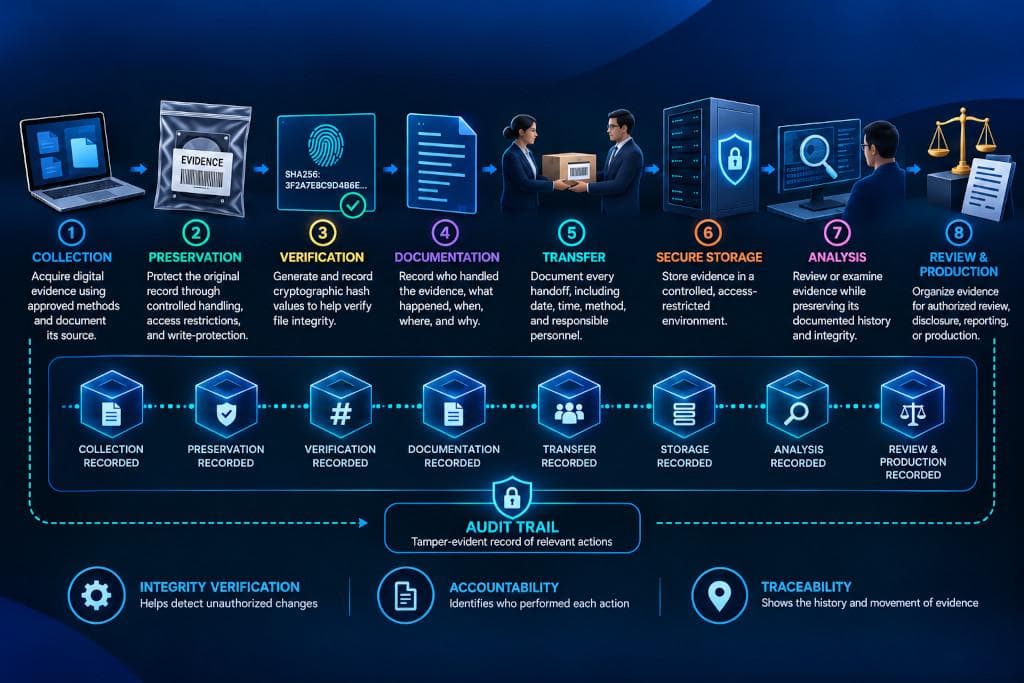
What is chain of custody?
Chain of custody is the documented history of a record, file, or item from the time it is created or collected until it is archived, transferred, reviewed, produced, or disposed of.
It records important events such as:
- Who created or collected the record
- When it was created, uploaded, accessed, or transferred
- Where it was stored
- Who viewed or downloaded it
- Whether it was changed, replaced, or deleted
- Which versions existed over time
- Who was responsible for each action
A well-maintained chain of custody helps demonstrate that a record has been properly controlled and that its history can be independently reviewed.
For digital records, this may include documents, emails, photographs, audio recordings, video files, contracts, investigation materials, transaction records, and other electronic information.
Why chain of custody matters
Digital files can be copied, renamed, moved, edited, replaced, or deleted without obvious physical evidence. A file may look unchanged while its contents, metadata, location, or access history has changed.
A reliable chain-of-custody process helps organizations answer questions such as:
- When was the file first received?
- Who uploaded it?
- Was it altered after upload?
- Which version was reviewed?
- Who had access to it?
- Was it transferred to another person or system?
- Can its current hash be compared with an earlier hash?
- Is there a complete and trustworthy audit history?
These questions matter when records are used for investigations, internal reviews, regulatory responses, litigation, audits, disputes, or business-critical decisions.
Chain of custody is therefore not simply about storing a file. It is about preserving the file’s history, integrity, and accountability throughout its lifecycle.
Chain of custody for digital records
For physical evidence, chain of custody may involve sealed packaging, custody forms, signatures, and documented transfers.
For digital records, the process requires appropriate technical and administrative controls. These may include:
- Identity verification
- Role-based access permissions
- Time-stamped audit logs
- Version history
- Controlled transfers
- Retention policies
- Legal holds
- Cryptographic hashing
- Integrity verification
- Secure storage
- Documented export and production procedures
The objective is to create a reliable record of what happened to the digital item and who was involved at each stage.
What can compromise a digital chain of custody?
A chain of custody may become difficult to verify when an organization:
- Stores files in personal devices or unmanaged folders
- Shares records through uncontrolled messaging channels
- Allows users to overwrite original files
- Fails to record access and download activity
- Uses shared accounts
- Deletes earlier versions
- Does not document transfers
- Has inconsistent timestamps
- Cannot identify who performed an action
- Lacks a reliable method of verifying file integrity
- Keeps audit logs separately from the records they describe
These weaknesses do not necessarily prove that a record has been altered. However, they can make the record’s history harder to establish and its integrity more difficult to defend.
The role of audit trails
An audit trail is a chronological record of activities performed on a file, record, account, or system.
Depending on the system and configuration, an audit trail may record:
- Creation and upload
- Access and viewing
- Downloads and exports
- Sharing
- Permission changes
- Version changes
- Transfers
- Retention actions
- Legal holds
- Deletion attempts
- Administrative activity
Audit trails help organizations understand how records were handled. They also support accountability by linking actions to identified users and recorded times.
An audit trail should be protected against unauthorized alteration. If users can freely edit or delete the history of their own actions, the audit trail may provide limited assurance.
Hashes and digital integrity
A cryptographic hash is a mathematical representation of a file’s contents. If the file changes, its hash will normally change as well.
Organizations can use hashes to compare:
- A file when it was received
- The same file when it was accessed later
- A file before and after transfer
- An archived file and a later exported copy
- A production copy and the original record
A matching hash does not, by itself, prove every fact about a record. It does not establish who created the file, whether the original source was reliable, or whether the correct file was selected. However, it can help verify that the contents of a particular file have remained unchanged since the relevant hash was recorded.
Merkle roots and large collections of records
When an organization manages many files, recording and verifying each file individually can become inefficient.
A Merkle tree allows multiple file hashes to be combined into a single summary value known as a Merkle root. The root can represent the state of a collection of records at a particular point in time.
Lexkeep can use cryptographic file hashes and Merkle-root structures to support efficient integrity verification across document, audio, and video records. The audit log can also be represented through its own Merkle-root structure, helping connect the history of system activity to a verifiable integrity record.
This approach can help organizations identify whether a file or audit event differs from the state that was previously recorded.
Blockchain anchoring as an additional verification layer
In practical terms, an organization may anchor a Merkle root to a blockchain so that a later verifier can compare the stored value with an independently recorded reference.
Blockchain anchoring is not a substitute for proper access controls, retention procedures, audit logging, or responsible records management. It does not automatically prove that the underlying document is authentic or that every event in its history was properly handled.
Its role is narrower: it can provide an additional integrity reference for information that has already been processed and recorded by the organization’s systems.
With Lexkeep, blockchain anchoring can be used as an additional verification layer, while file hashes, file Merkle roots, and audit-log Merkle roots support the platform’s standard integrity architecture.
Chain of custody and legal or business records
Chain-of-custody controls are relevant wherever the history and integrity of a record matter.
Examples include:
Legal departments and law firms
Legal teams may need to manage contracts, pleadings, correspondence, evidence, matter files, recordings, and documents subject to legal holds.
Investigations
Investigation teams may handle interviews, photographs, video recordings, reports, communications, and other sensitive materials that must be carefully preserved.
Compliance and audit
Compliance teams may need to demonstrate how policies, approvals, reports, or regulated records were created, reviewed, stored, and accessed.
Human resources
HR departments may manage investigation records, employee complaints, disciplinary materials, and confidential audio or video files.
Financial and regulated businesses
Organizations may need to preserve transaction records, approvals, communications, customer files, and evidence of internal controls.
Government and public-sector organizations
Public bodies may require controlled retention, access accountability, preservation, and reliable retrieval of official records.
How Lexkeep supports chain of custody
Lexkeep is a software solutions provider for secure document and records management. Its platform helps organizations manage the lifecycle of important documents, audio, and video records while maintaining visibility into how those records are handled.
Lexkeep supports chain-of-custody processes through capabilities such as:
- Controlled record storage
- Access permissions
- User accountability
- Version history
- Time-stamped activity records
- Audit-log management
- Retention and preservation controls
- Legal-hold support
- Cryptographic file hashing
- File-hash Merkle roots
- Audit-log Merkle roots
- Integrity verification
- Blockchain anchoring
These capabilities are designed to help organizations preserve a transparent and verifiable history of their records.
Lexkeep does not replace an organization’s legal, compliance, investigative, or records-management procedures. Instead, it provides the software infrastructure needed to implement those procedures more consistently and to produce a clearer record of what happened to important information.
Practical chain-of-custody workflow
A defensible digital records process may include the following steps:
1. Identify the record
Determine what the record is, where it came from, who supplied it, and why it must be preserved.
2. Capture the record
Upload or ingest the file through a controlled process. Record relevant details such as the source, date, responsible user, and matter or classification.
3. Generate an integrity reference
Create a cryptographic hash for the file and associate it with the record’s metadata and audit history.
4. Restrict access
Apply permissions based on role, matter, department, sensitivity, or business need.
5. Record activity
Capture access, viewing, downloading, sharing, versioning, transfer, retention, and other relevant events.
6. Preserve the record
Apply retention requirements, legal holds, preservation controls, or other restrictions against unauthorized deletion or alteration.
7. Verify when needed
Compare the current file hash with the recorded hash or use the relevant Merkle-root data to verify the integrity of the record or collection.
8. Document production or transfer
When a record is exported, disclosed, transferred, or provided for review, record who performed the action, when it occurred, and what was supplied.
9. Retain or dispose of the record
Follow the applicable retention schedule and document the final disposition in accordance with the organization’s policies.
Chain of custody is a process, not just a feature
No single technology creates a complete chain of custody on its own.
A reliable process combines:
- Clear policies
- Trained personnel
- Appropriate permissions
- Controlled systems
- Complete audit records
- Integrity verification
- Documented transfers
- Proper retention and preservation procedures
Hashing, Merkle roots, audit trails, and blockchain anchoring can strengthen the technical foundation of the process. They should operate alongside sound governance and documented procedures.
Protect the history of your electronic records with Lexkeep
Important records need more than a place to be stored. Organizations need to know where records came from, who accessed them, what happened to them, and whether their contents remain consistent with the preserved version.
Lexkeep helps organizations manage documents, audio, and video records with stronger accountability and verifiable integrity. Through controlled access, audit trails, cryptographic hashing, Merkle-root verification, and blockchain anchoring, Lexkeep provides a practical foundation for managing digital chain of custody.